
A Catalytic Converter Runs Two Opposite Reactions at Once, and Only Inside a Very Narrow Window
Burning carbon monoxide and unburnt fuel needs oxygen. Stripping nitrogen oxides back to nitrogen needs oxygen taken away. A three-way cat does both in the same brick, which is the whole reason closed-loop fuelling and the oxygen sensor exist.
- Regulated pollutants
- CO, unburnt HC, NOx
- Substrate
- Cordierite or metallic honeycomb
- Active metals
- Platinum, palladium, rhodium
- Operating target
- λ = 1 (about 14.7
- Light-off
- roughly 350 °C
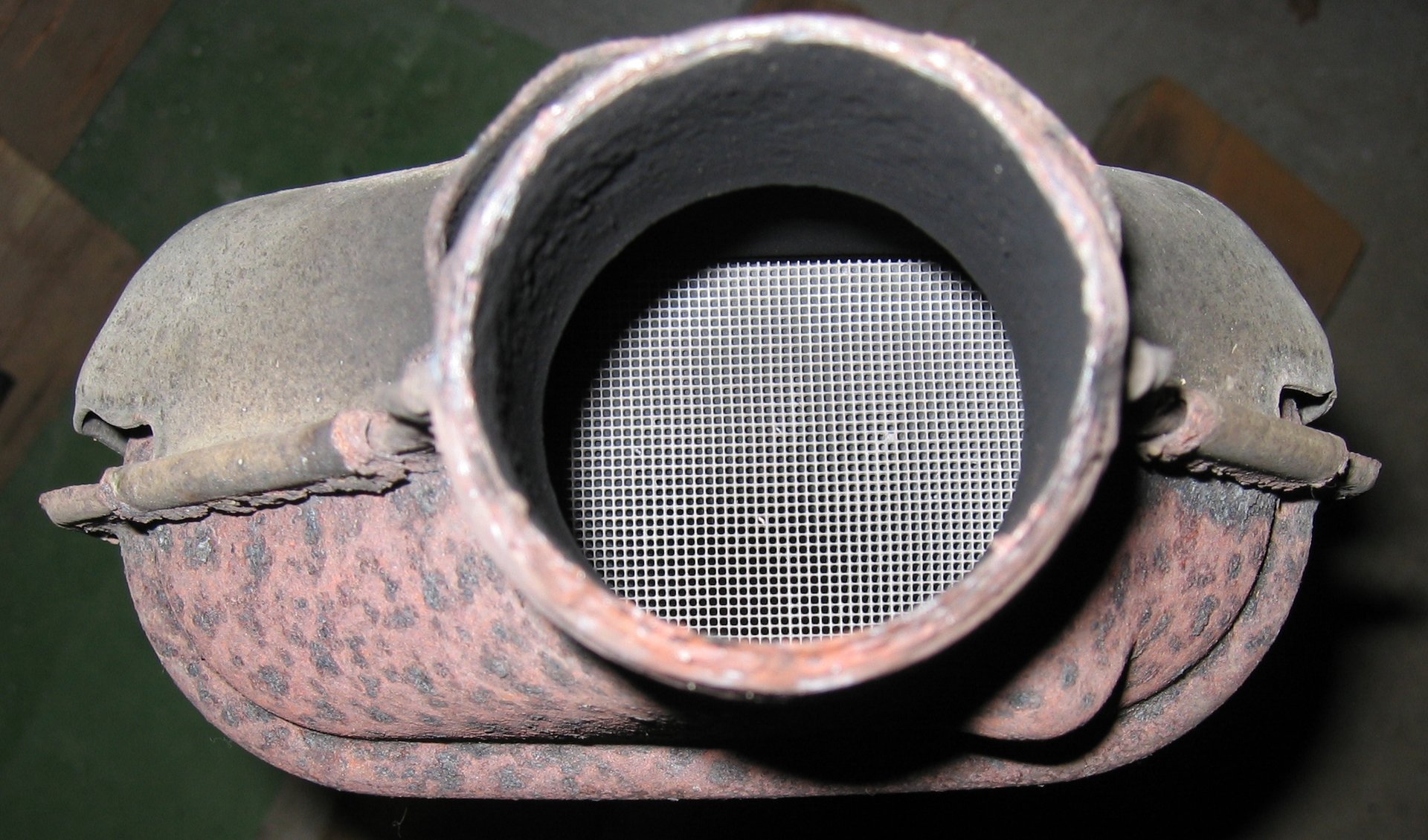
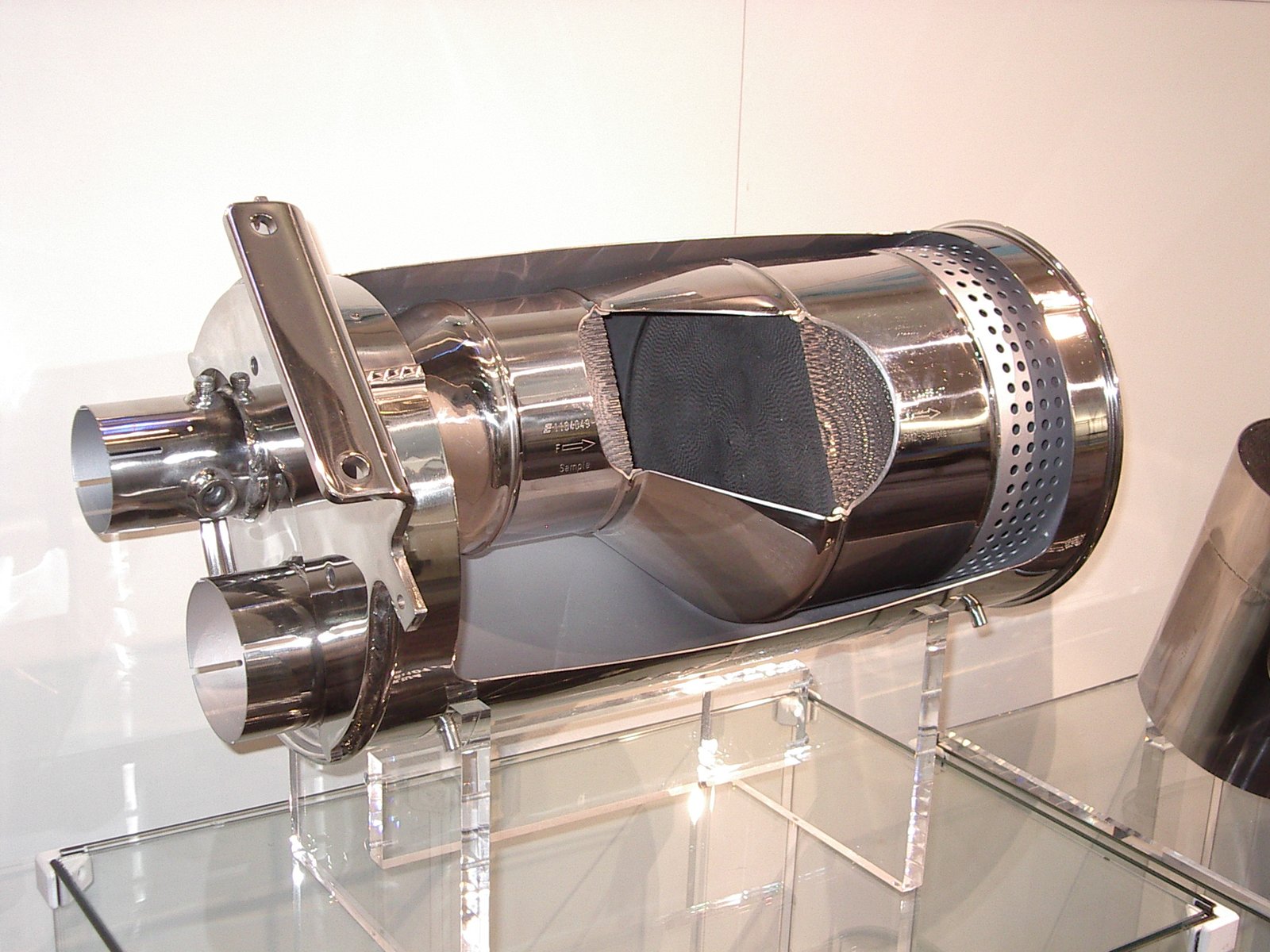
Cut one open and there is almost nothing to it. A steel can, a wrap of fibrous mat to stop the fragile bit rattling around inside it, and in the middle a cylinder of ceramic honeycomb with walls thin enough to look like graph paper. No moving parts, no electronics, nothing that wears in any mechanical sense. What that honeycomb does is handle three regulated pollutants that a spark-ignition engine cannot avoid producing: carbon monoxide, unburnt and partially burnt hydrocarbons, and oxides of nitrogen. Dealing with all three in one brick is where the name comes from. A three-way catalyst is three-way because it has three jobs, not three stages.
"A catalytic converter is a simple device. It's got no moving parts and it rarely fails on its own." — AP Emissions Technologies
Two of those jobs are oxidations and they are easy to understand. Carbon monoxide picks up oxygen and becomes carbon dioxide. Unburnt fuel — the hydrocarbons that slipped past combustion, written generically as CxHy — picks up oxygen and becomes carbon dioxide and water. Both reactions want oxygen present. The third job runs in the opposite direction. Nitric oxide and nitrogen dioxide, formed when combustion gets hot enough to make atmospheric nitrogen and oxygen react with each other, have to be reduced back to ordinary diatomic nitrogen. On a catalyst surface the carbon monoxide does that work directly: CO plus NO gives CO2 and nitrogen. Hydrogen present in the exhaust does the same thing, giving water and nitrogen. That reaction wants oxygen scarce. Oxidation needs oxygen, reduction needs the absence of it, and the converter is asked to do both in the same volume of gas at the same instant. Everything awkward about catalytic converters follows from that one contradiction.
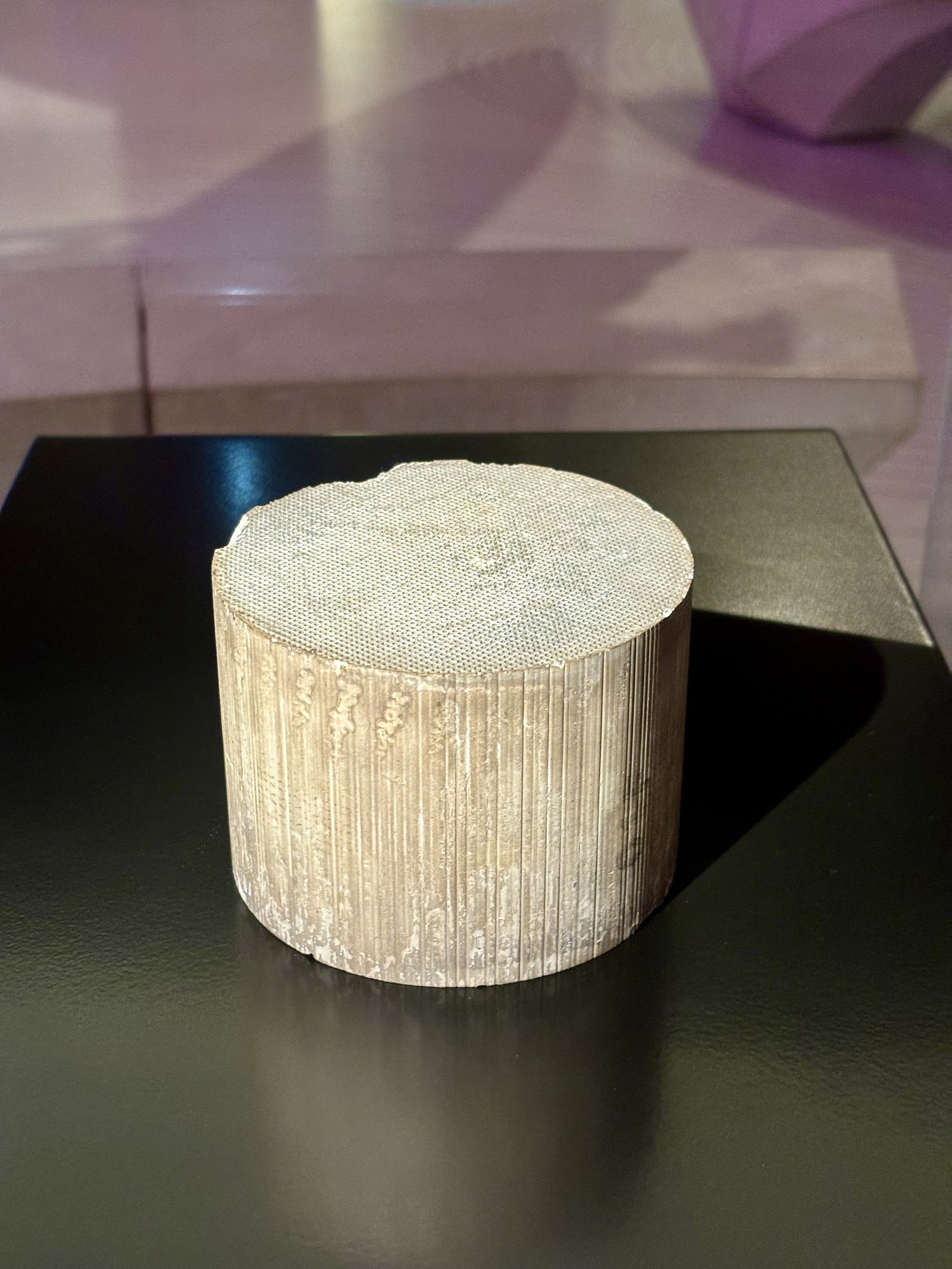
The hardware exists to make the contradiction survivable. The substrate is almost always cordierite, a magnesium-aluminium-silicate ceramic extruded as a honeycomb, a material and a process worked out at Corning in the early 1970s by Rodney Bagley, Irwin Lachman and Ronald Lewis, who were inducted into the National Inventors Hall of Fame for it in 2002. The first successful 4.66-inch extrusion came in 1971 and Ford had placed an order by the end of that year. Cordierite was chosen because it barely changes dimension when it is heated and cooled hard, which is what living in an exhaust pipe amounts to. Where heat resistance has to be higher still, the substrate is rolled metal foil instead, usually a FeCrAl alloy of the Kanthal type. Cell density is a design choice: a close-coupled unit sitting right behind the manifold may run 750 or 900 cells per square inch to light quickly, while an underfloor brick is typically around 400. The honeycomb geometry was picked precisely because it delivers an enormous surface area for very little pressure drop, which matters later.
The ceramic itself is catalytically useless. What does the work is a washcoat — aluminium oxide, sometimes with titania or silica — applied as a deliberately rough, porous layer so that a few grams of precious metal can be spread across a surface area out of all proportion to the size of the part. The metals are not interchangeable. Rhodium is the reduction catalyst, the one that actually breaks up NOx. Palladium is the oxidation catalyst. Platinum will do both, which is why it was the original workhorse, though which of the three is cheapest has swapped around repeatedly as the markets have moved. Mixed into the washcoat is cerium oxide, usually as a ceria-zirconia, which is there as an oxygen buffer: cerium flips between its +4 and +3 states, storing oxygen when there is a surplus and releasing it when there is not.
That buffer is what makes the contradiction workable, and it only has enough capacity to cover a very small excursion. Stoichiometric combustion of pump petrol is about 14.7 parts air to one part fuel by mass, the point conventionally normalised to lambda = 1. The band around lambda = 1 inside which all three pollutants are converted at a useful rate is narrow in a way that is easy to under-appreciate: on the order of a few hundredths of an air-fuel-ratio unit, measured against that 14.7. Stray lean and the engine makes more NOx while the catalyst loses the ability to reduce it. Stray rich and CO and hydrocarbon output climbs while the oxygen to burn them disappears. There is no setting that is merely acceptable on both sides, which is why a modern engine does not try to sit still. The control system deliberately dithers, swinging slightly rich so stored oxygen gets spent oxidising CO under conditions that favour NOx reduction, then slightly lean to oxidise hydrocarbons and recharge the ceria, and back again. The oxygen sensor in the exhaust is what closes that loop. Closed-loop fuelling is not a refinement bolted onto the catalytic converter; without it there is no three-way catalyst at all.
None of it happens cold. A catalyst does essentially nothing until it reaches light-off, which the EPA puts at around 350 °C for conventional formulations, and that is the single most important fact about real-world tailpipe emissions. EPA research summaries have put something like 70 to 80 percent of a test cycle's exhaust emissions in the first minute or two after a cold start, when the engine is running rich, the oxygen sensor is not yet in control, and the brick downstream is inert. Work at UT Austin using EPA's MOVES model found cold starts accounting for up to 80 percent of total emissions for some pollutant species, with the engine and converter generally warmed after three to four minutes. Every cold-start countermeasure on a modern car is an attempt to shorten that window. Close-coupled converters are mounted hard up against the exhaust manifold so they see the hottest gas soonest. Secondary air injection — a technique that predates catalysts, introduced in 1966 — pumps fresh air into the exhaust ports so the rich warm-up mixture burns in the pipe and heats the catalyst on its way past. Electric heating is the brute-force answer: Alpina put an electrically heated catalyst into production in 1995 on the B12 5.7 E-KAT, developed with Emitec and BMW, and BMW brought the same idea to the 750i in 1999. It has come back for the same reason it arrived, with Vitesco winning a volume order in 2020 for 48-volt heating elements on diesel mild hybrids entering production in 2022, where heating the SCR catalyst cut NOx by 40 percent over WLTP and 62 percent on the urban cycle.
Converters do not wear out so much as get killed, and the ways they die are specific. Lead is the original poison, the reason unleaded fuel exists at all, and the damage is not reversible. Phosphorus is the chronic one: it comes from zinc dialkyldithiophosphate anti-wear additives in engine oil, reaching the exhaust whenever oil gets past rings or valve seals, where it deposits on or reacts with the washcoat's alumina and ceria, costing surface area and oxygen-storage capacity. The problem was serious enough that the API SM and ILSAC GF-4 oil specifications adopted phosphorus limits in 2004. Silicon arrives when coolant leaks into the combustion chamber, typically through a head gasket, and silicone sealants and some assembly chemicals contribute the same element. Sulphur in fuel suppresses activity. Manganese from the fuel additive MMT does its own damage. And then there is thermal destruction, which is faster and more dramatic than any of these: a misfiring cylinder pumps raw fuel and oxygen straight into a hot catalyst, that mixture burns inside the brick rather than in the engine, and the substrate can melt outright. Cordierite's melting point is around 1,200 °C, against modern converters being designed to tolerate sustained operation near 900 °C. The margin is not large.
Which brings up the most misread diagnostic code on the planet. P0420 reads "catalyst system efficiency below threshold, bank 1", and it is not a direct measurement of the catalyst at all. It is an inference drawn from comparing two oxygen sensors. When the converter is working, its ceria is absorbing and releasing oxygen fast enough to smooth out the engine's deliberate rich-lean dither, so the upstream sensor switches rapidly while the downstream sensor traces something close to a flat line. When the downstream sensor starts mirroring the upstream one, the ECU concludes the buffering has stopped and sets the code. An exhaust leak near a sensor, a failed sensor, a misfire, or an engine quietly burning oil will all produce that signature, and in the last two cases the converter probably is damaged — but replacing it without finding out why is paying for the same part twice. AP Emissions, which manufactures the things, puts it plainly in its own technician training: "A catalytic converter is a simple device. It's got no moving parts and it rarely fails on its own. When a catalytic converter fails and you get a P0420 or 430 code, it's the technician's job to put on their detective hat and figure out what killed the cat."
The honest caveat is that a converter is a restriction. Any device you put in an exhaust stream costs some pressure, and in a gasoline system the catalyst is a meaningful share of the total exhaust-side loss. The question is magnitude, and the folklore is wildly out of date — it dates from the 1970s and early 1980s, when converters really were crude and cars really did gain from losing them. Modern measurements do not support it. A 2006 Import Tuner test on a 1999 Honda Civic found that removing the stock converter entirely bought a 3 percent increase in peak horsepower, and that fitting a metallic-core converter in its place cost 1 percent against running no converter at all. Grassroots Motorsports ran a spread of SCCA-legal converters against a straight test pipe on a Miata and found differences of one to two horsepower, at the top of the rev range, between a bare pipe and the best of the cats. That is the real size of the prize: a rounding error on a dyno, in exchange for the part that does more to clean a car's exhaust than everything else on the vehicle combined.
The theft problem is a pure metals-price story, and the numbers tell it clearly. Rhodium's Johnson Matthey base price hit roughly $29,800 an ounce in March 2021, a level that made the few grams in an exhaust pipe worth cutting out with a cordless saw. National Insurance Crime Bureau figures went from 1,298 reported converter thefts in 2018 to 14,433 in 2020, and published research put US thefts at around 153,000 in 2022; the same work estimated a price elasticity near 1.98, meaning a 10 percent rise in metal price drives roughly a 20 percent rise in thefts. Prices have come a long way off that peak — as of today rhodium is quoted in the $8,400 to $9,000 range, with platinum around $1,700 and palladium around $1,170 — and theft volumes have fallen with them. But rhodium is still worth roughly five times what platinum is, so the incentive has shrunk rather than vanished.
Diesel cannot use any of this, and the reason is the same contradiction viewed from the other end. A compression-ignition engine runs lean at every operating point and its exhaust always contains surplus oxygen, so the reduction half of the three-way reaction has nothing to work with. Diesel aftertreatment therefore splits the jobs across separate devices. A diesel oxidation catalyst, palladium or platinum on alumina, handles CO and hydrocarbons. A wall-flow diesel particulate filter — alternate channels plugged at opposite ends so gas is forced through porous walls — traps soot, typically removing 85 percent or more, and is periodically regenerated by raising exhaust temperature enough to burn the trapped carbon off. NOx gets its own box: selective catalytic reduction, fed with diesel exhaust fluid, which is 32.5 percent urea in deionised water. Injected into hot exhaust, the water flashes off and the urea decomposes thermally into ammonia and isocyanic acid, and the isocyanic acid hydrolyses with water vapour to give carbon dioxide and more ammonia. That ammonia is the actual reducing agent, reacting over the SCR catalyst along the lines of four NO plus four NH3 plus O2 giving four N2 and six H2O. Three devices, one chemistry problem, and a tank of urea you have to remember to fill — which is the price of running lean, and a decent illustration of how much a single petrol three-way catalyst is quietly doing.

800 Volts Doesn't Make a Car Charge Faster. It Removes the Reason It Couldn't.
Double the pack voltage and you halve the current for the same power — and heat falls with the square of current. That's the entire trick. It still doesn't guarantee you a quick charge, and it quietly creates a compatibility problem nobody advertises.
Electric Power Steering Won on Physics. The Missing Feel Was a Tuning Decision.
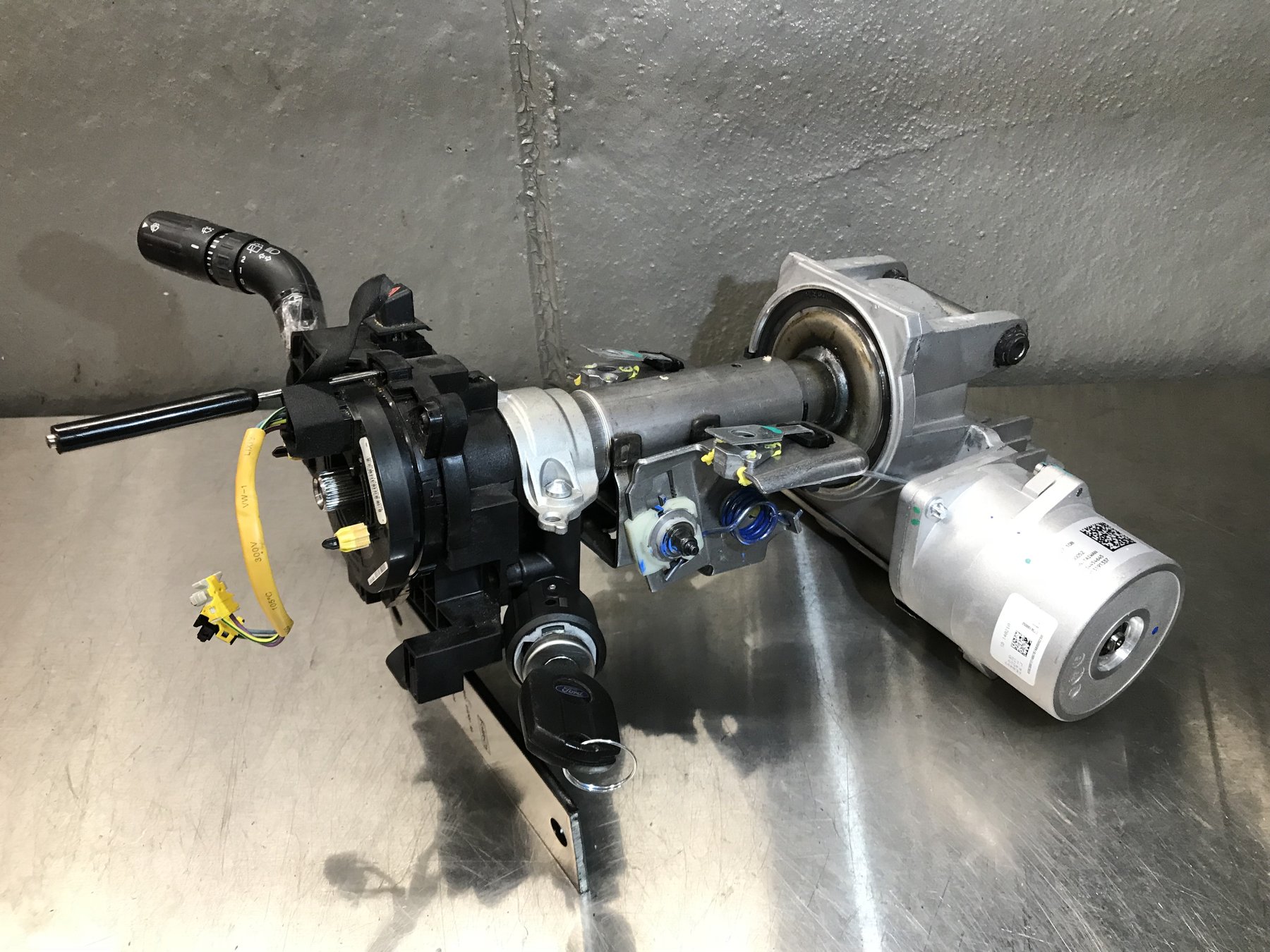
A hydraulic rack burns engine power whether you are steering or not, and it cannot steer itself — which is why it lost. But "no feel" is not an inevitable consequence of putting a motor in the loop. It is what happens when inertia, friction and software go unaddressed.
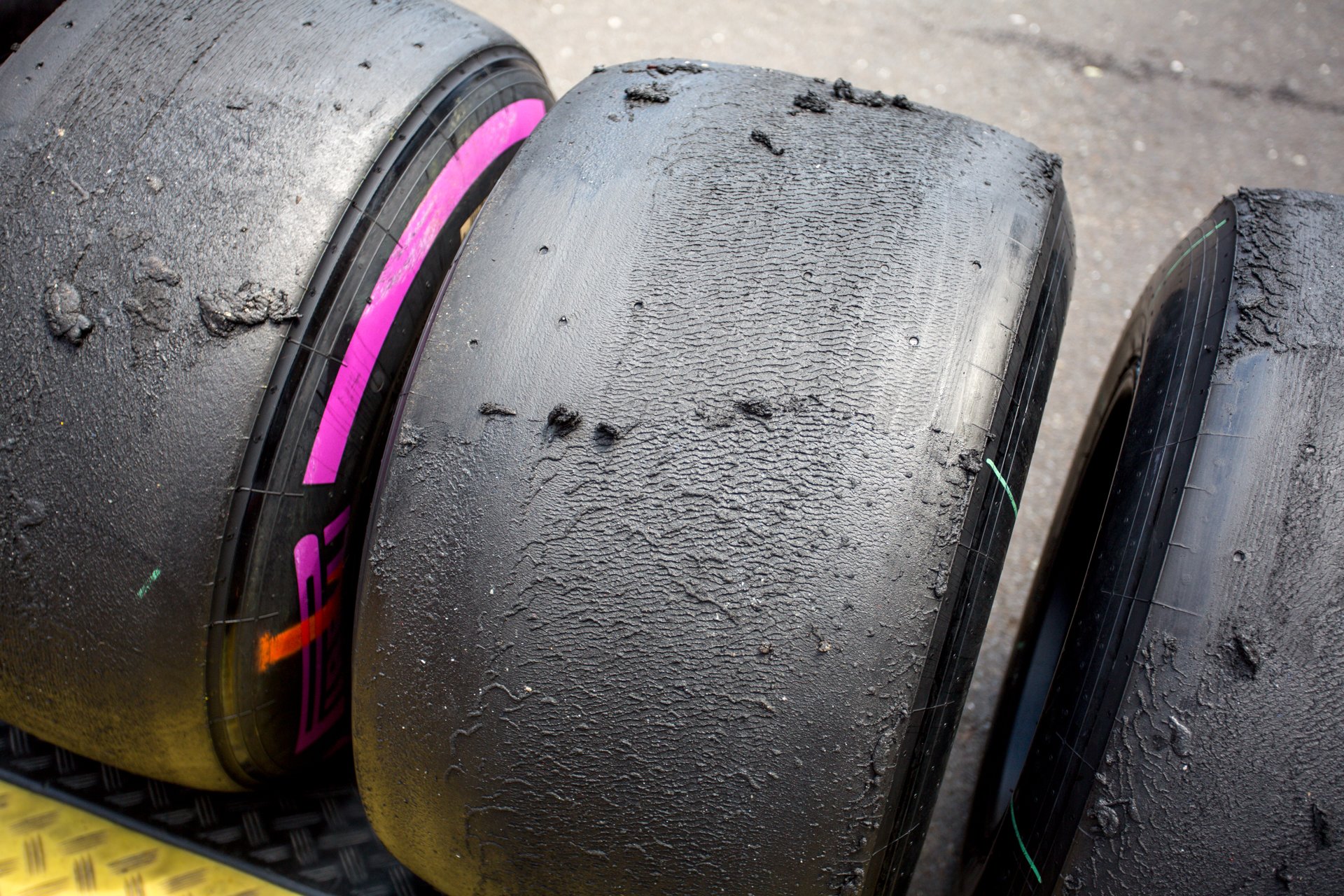
How a Tyre Actually Makes Grip
The textbook friction formula says grip ignores contact area and can’t exceed the load pressing down. Rubber breaks both rules, and understanding why explains almost everything a car does at the limit.