
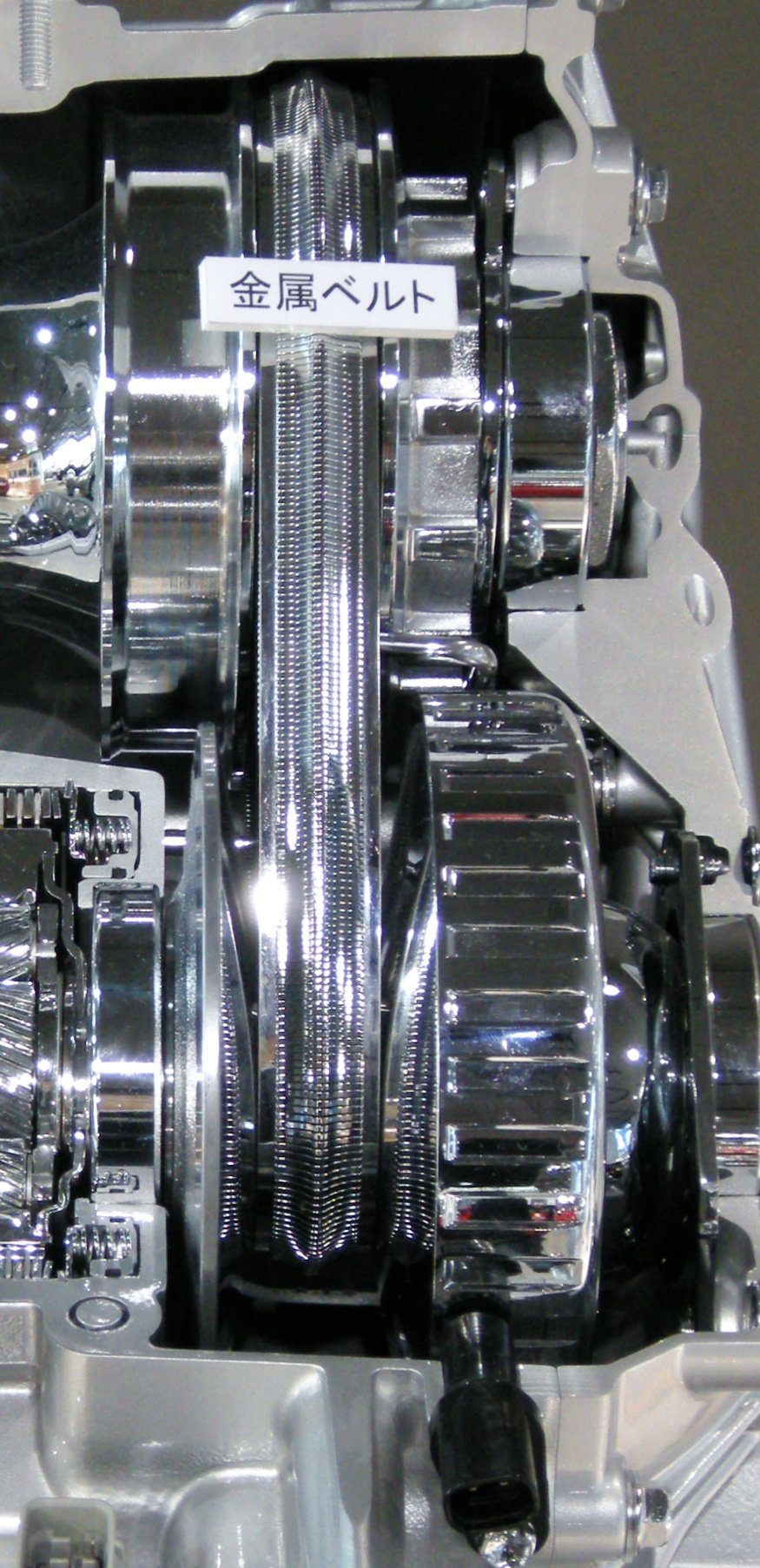
A CVT Doesn't Shift Gears. It Never Stops Changing Its Ratio.
Two cone-shaped pulleys and a steel belt replace the fixed steps of a normal gearbox with one ratio that slides continuously, which is exactly why a CVT-equipped car never quite feels like it's shifting.
A conventional automatic has a fixed menu of gear ratios and picks the closest one to what the engine wants. A continuously variable transmission doesn't pick from a menu at all. In the most common design, two pulleys sit connected by a metal belt, and each pulley is split into two cone-shaped halves, one fixed in place and one that can slide toward or away from it. Squeeze the halves together and the belt gets pushed outward, riding higher on the cone and turning at a larger effective diameter. Pull them apart and the belt drops down into the V, spinning at a smaller diameter. Because the two pulleys move in opposite directions at once, the belt's overall path length never changes, but the ratio between input and output speed can land anywhere across the unit's range, not just at a handful of preset stops.
That's the whole trick, and it's why the transmission has no fixed gear ratios to speak of. A stepped automatic or a manual has to jump between discrete ratios because its gears are physical objects of fixed size that either mesh or don't. A CVT's "gear" is just wherever the pulleys happen to be squeezed to at that instant, adjusted by hydraulic pressure acting on the movable cone halves. That lets the control system hold the engine at whatever RPM makes the most power or the best fuel economy for the conditions, then keep it there as road speed climbs, rather than letting revs rise and fall with each gear change.
The belt itself is usually not rubber. Most modern automotive CVTs use a metal push-belt made of hundreds of thin steel links compressed between two steel bands, a design that traces back to work by Van Doorne's Transmissie in the Netherlands and is now built by Bosch, which supplies or licenses the technology across the industry. Some manufacturers use a link-plate steel chain instead of a push-belt for higher-torque applications; Subaru's CVTs, for example, use a chain-based design in some of its heavier-duty units. The first mass-production car to use any CVT was the 1958 DAF 600, whose Variomatic transmission (belt-and-pulley, just like today's units) stayed in production across DAF and later Volvo models into the 1980s.
There's a second, much rarer CVT layout that skips belts entirely: the toroidal or "traction drive" design, which uses discs shaped to form a torus, with rollers wedged between them that tilt to change where they contact each disc. Moving the roller's contact point changes the effective ratio the same way sliding a belt up or down a pulley does. Nissan built the only major production example, marketed as Extroid, in the 1999 Cedric Y34; toroidal units can handle more torque than a belt but never caught on the way pulley-based CVTs did, largely on cost and complexity.
None of this resembles how a torque-converter automatic or a dual-clutch transmission works, even though all three get badged simply as "automatic." A torque-converter automatic uses a fluid coupling, an impeller spinning fluid that drives a turbine, to link the engine to a planetary gearset. Different physical elements of that gearset get locked or freed by clutches and bands, and each combination produces one of a fixed number of ratios: still discrete steps, just automated ones. A dual-clutch transmission is closer to a manual gearbox split in two, with one clutch controlling the odd-numbered gears and the other the even-numbered ones, so the next gear can be pre-selected and swapped in almost instantly. It's fast specifically because it's still shifting between fixed, physical gears. A CVT is the odd one out: no gearset, no clutch pack shuffling between ratios, just a belt sliding across a continuous range.
That continuity is also the reason some drivers can't stand the way a CVT feels. Because there's no discrete ratio to hold onto, hard acceleration tends to produce what's commonly called the rubber-band effect: engine revs flare up toward a set point and hang there, drone included, while the car's actual speed slowly catches up, instead of the rising-and-falling cadence people associate with gear changes. Manufacturers building CVTs for enthusiast-oriented cars have tried to paper over this by programming the transmission to simulate fixed steps. Subaru's WRX, for instance, offers an eight-step manual mode with paddle shifters on its CVT-equipped "Subaru Performance Transmission," faking the feel of a conventional gearbox on top of a mechanism that doesn't actually have one.
Belt-and-pulley CVTs remain common in mainstream cars because of what they're good at: keeping an engine parked at its efficient RPM band regardless of speed, something a stepped transmission can only approximate. Nissan's Xtronic and Toyota's Super CVT-i, both widely used across mainstream lineups, are built on exactly the same core idea as the DAF 600's Variomatic from 1958, two pulleys and a belt, refined with electronic control and stronger materials but mechanically unchanged in principle.
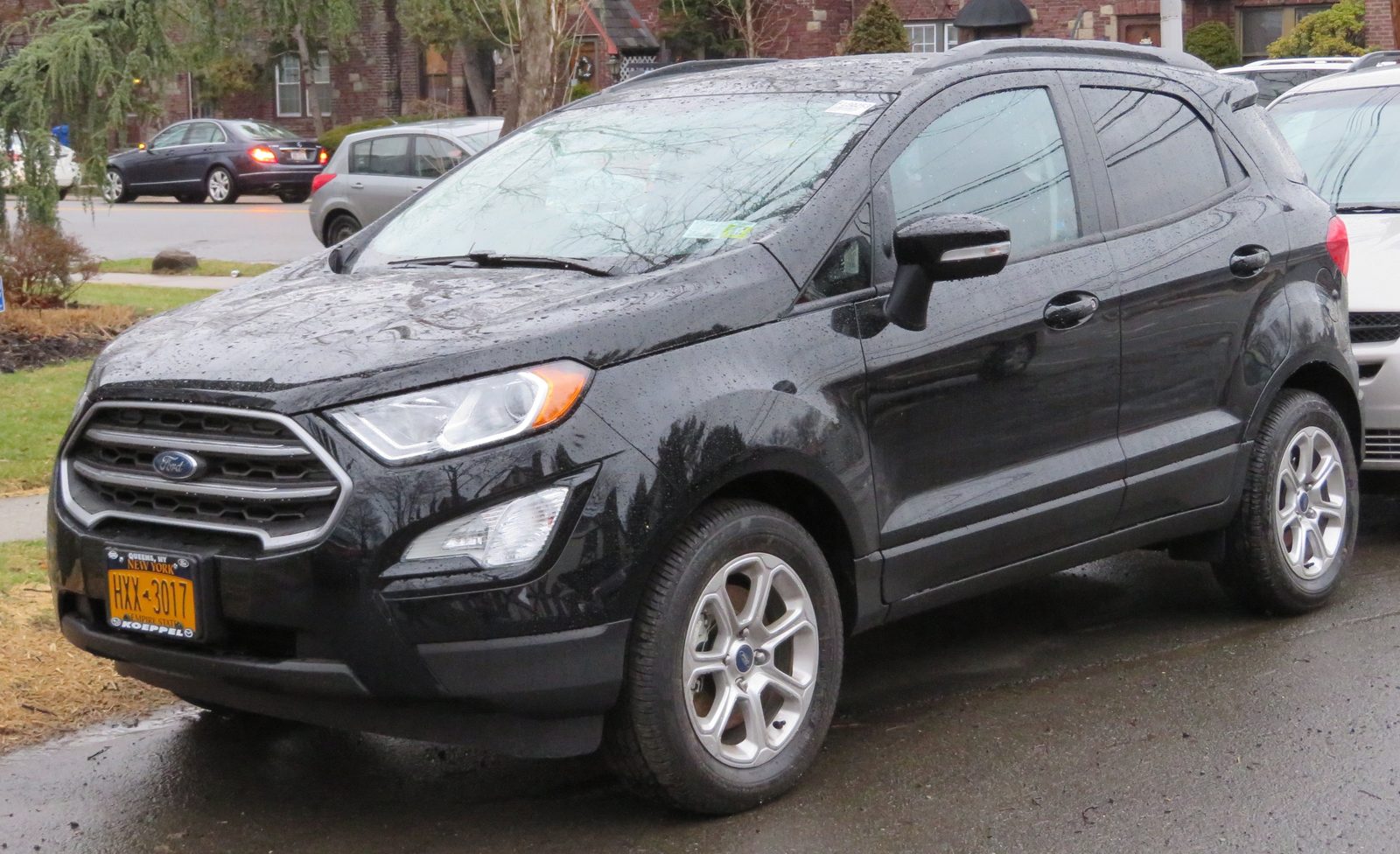
Ford Ran the Timing Belt Through the Oil. Federal Investigators Say the Belt Is Now Starving the Engine.
A belt-in-oil drive is quieter and lower-friction than a chain. NHTSA's new engineering analysis says the 1.0-liter EcoBoost's belt sheds material that clogs the oil pump pickup — and that screen can't be cleaned without pulling the engine.
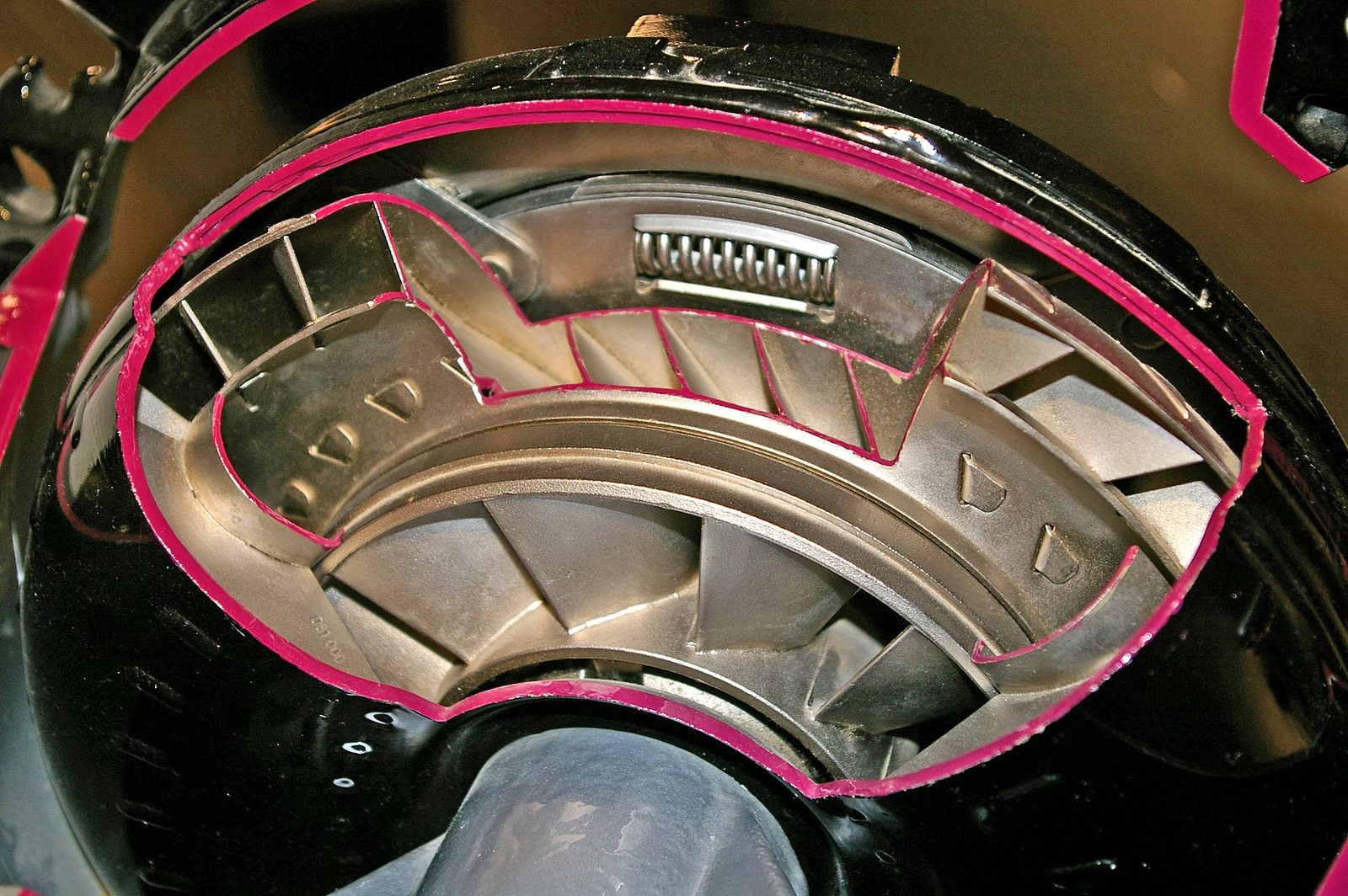
The Automatic's Oldest Trick: How a Torque Converter Multiplies Torque With No Gears
It has no gear teeth and nothing that meshes, yet a torque converter can roughly double engine torque off the line. The part doing the work is the one bolted to nothing at all.
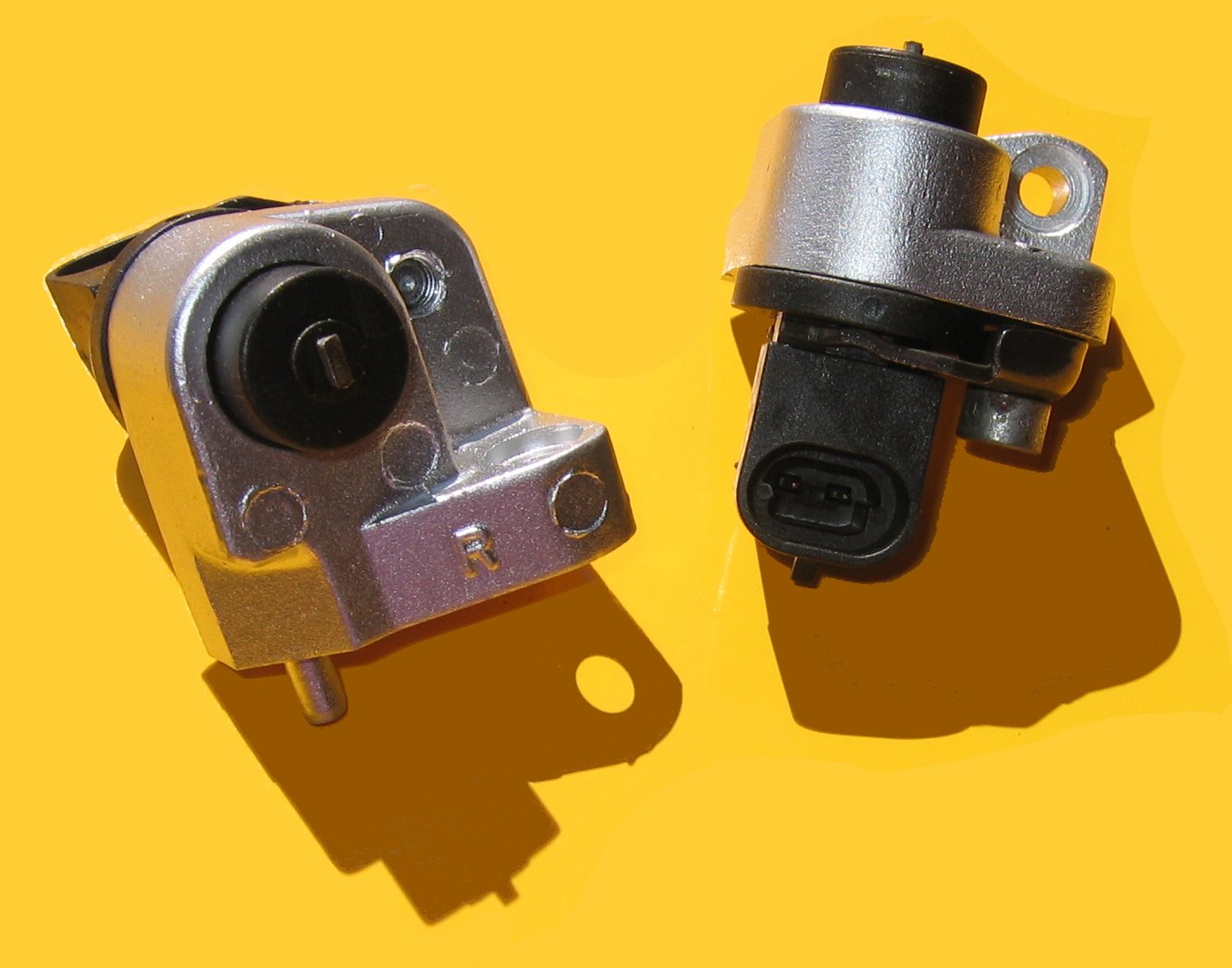
How Electronic Stability Control Reads a Slide and Corrects It Before the Driver Even Feels It
A network of wheel-speed, steering-angle, and yaw sensors checks the car's actual path against the driver's intended one many times a second — and brakes a single wheel to pull it back if the two disagree.