
Downforce Is an Upside-Down Wing — and at 40 MPH It's Doing Almost Nothing
The physics of aerodynamic grip is simpler than the mythology around it, and far more speed-dependent than most people assume. Here's the actual mechanism, the schoolbook explanation that's wrong, and why the wing on a hatchback's trunk lid is decoration.
- 992 GT3 RS downforce @ 124 mph
- 901 lb
- Downforce @ 177 mph
- 1,896 lb
- Low-downforce drag coefficient
- 0.39
- Top speed
- 184 mph
Strip away the carbon fibre and the marketing, and a race car's rear wing is an aircraft wing fitted upside down. An aeroplane's wing is shaped and angled so the air passing over the top is moving faster, and therefore at lower pressure, than the air underneath; the pressure difference across the surface, integrated over the whole wing, is lift. Turn that section over and you get the same force pointed at the road. That's all downforce is — a deliberate, engineered pressure imbalance that pushes the tyres into the tarmac harder than the car's own weight does. The tyre doesn't know or care where the load came from. It just knows it's being squeezed, and a squeezed tyre generates more lateral force.
"The one thing that's been completely misreported in all the books and magazines is that the car was banned. It was never banned." — Gordon Murray on the Brabham BT46B, Motor Sport
The explanation most of us got in school — that air has to travel a longer distance over the curved top surface, so it must speed up to "meet" the air from underneath at the trailing edge — is simply wrong, and NASA says so in plain language. Its Glenn Research Center maintains a page specifically debunking what it calls the "Equal Transit" or "Longer Path" theory. Three problems: symmetric and flat-plate aerofoils generate lift despite having no longer upper surface at all; wind-tunnel measurement shows the air over the top arrives at the trailing edge well before the air underneath, so the molecules never meet up as claimed; and if you take the velocity that theory predicts and run it through Bernoulli's equation, you get far less lift than the wing actually produces. Bernoulli's principle isn't the problem — the non-physical assumption bolted onto it is.
There's a second description that is equally correct and often framed as a rival: the Newtonian one. A wing turns a large mass of air downward (or, inverted, upward), and by the third law the air pushes back with an equal and opposite force. NASA's position is that these aren't competing theories at all. Integrate the pressure distribution around the surface and you get the force; account for the momentum change in the deflected flow and you get the same force. As the agency's own page puts it, "So both 'Bernoulli' and 'Newton' are correct," and the arguments arise because people mis-apply the equations and over-simplify. A wing that makes downforce is, at the same time, a device that lowers pressure on its underside and a device that throws air upward. Those are two accounts of one event.
How hard the wing works depends on its angle to the oncoming air — the angle of attack — and that relationship is linear only up to a point. NASA notes that lift varies almost linearly for small angles, roughly within ten degrees either side of zero. Push past the critical angle and the boundary layer, the thin skin of slow-moving air clinging to the surface, can no longer fight its way against the rising pressure toward the trailing edge. It separates, the attached flow collapses into a turbulent mess, and the wing stalls: force falls off a cliff while drag spikes. The critical angle for most subsonic aerofoils sits somewhere in the region of eight to twenty degrees, commonly cited around fifteen, but it depends on section, Reynolds number and surface condition. NASA is blunt that predicting the exact stall point mathematically is very difficult, which is why aerodynamicists still spend their lives in wind tunnels.
Now the part that governs how downforce actually feels from the driver's seat. The lift equation is L = Cl × A × ½ρV², and the only term that changes with pace is V — squared. Double the speed and you quadruple the force. The car's mass, meanwhile, does not change with speed at all. So the grip a car gets from its own weight pressing the tyres down is a constant, while the grip it gets from aerodynamics is a curve that starts at zero and climbs steeply. Run the numbers on a corner taken at 40 mph versus one at 140: the ratio is (40/140)², which means the aero package is making about eight percent of the force it makes at the higher speed. A car with a genuinely serious wing and floor can be pulling multiples of its own weight through a fast sweeper and have essentially nothing extra in a hairpin. That's why race drivers talk about trusting the car in high-speed corners and why the same car can feel ordinary, even nervous, in slow ones.
None of it is free. A wing that produces downforce also produces drag, and the measure of how well it's doing its job is the lift-to-drag ratio — the lift coefficient divided by the drag coefficient, which NASA describes straightforwardly as an indication of aerodynamic efficiency. Every unit of downforce costs top speed and fuel. This is the central trade of race car aerodynamics: a steeper wing buys cornering speed and sells straight-line pace, and the optimum shifts from circuit to circuit. It's also why the most prized downforce is the kind that comes cheaply in drag, which brings us underneath the car.
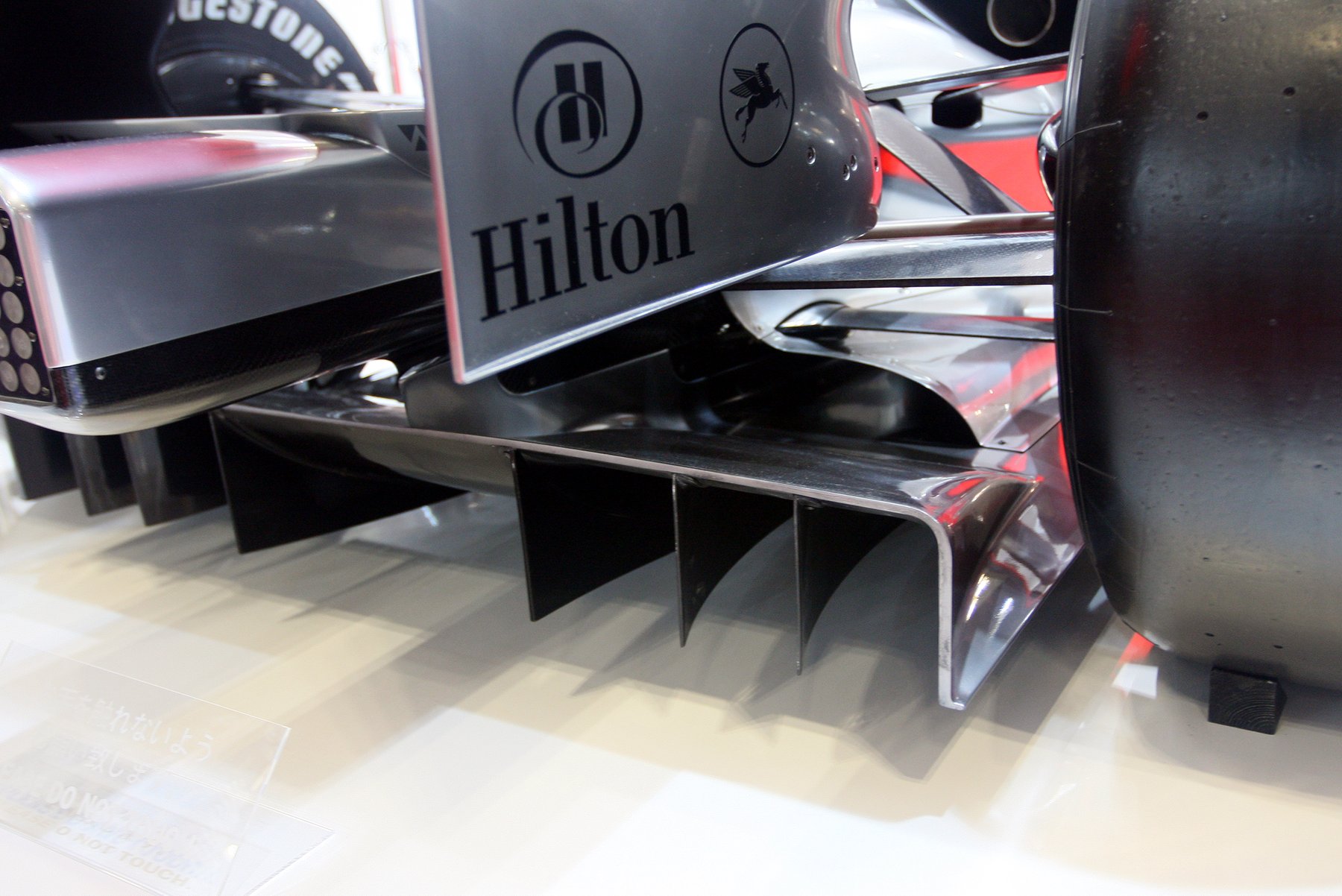
The underbody is where the real work happens. If you shape the floor so it narrows toward the ground and then expands again at the rear — a venturi, in effect, with the road surface forming one wall of the duct — the air accelerates through the restriction and its pressure drops, sucking the whole car down. The diffuser at the back is the expanding section that lets that fast, low-pressure air decelerate and recover back to ambient pressure as it exits. Proximity to the road matters because the road is part of the duct: the smaller the gap, the more the flow is constrained and accelerated, so downforce climbs as ride height falls. It does not climb forever. Willem Toet, the former head of aerodynamics at Ferrari's F1 team, has written that real motorsport diffusers run at expansion angles far steeper than a conventional duct could tolerate because the flow is vortex-dominated — vortices roll up along the floor edges and drag high-energy air in — and that below a critical ride height one of those vortices bursts, causing an abrupt downforce loss and hysteresis, so the car behaves differently coming down to that height than going back up.
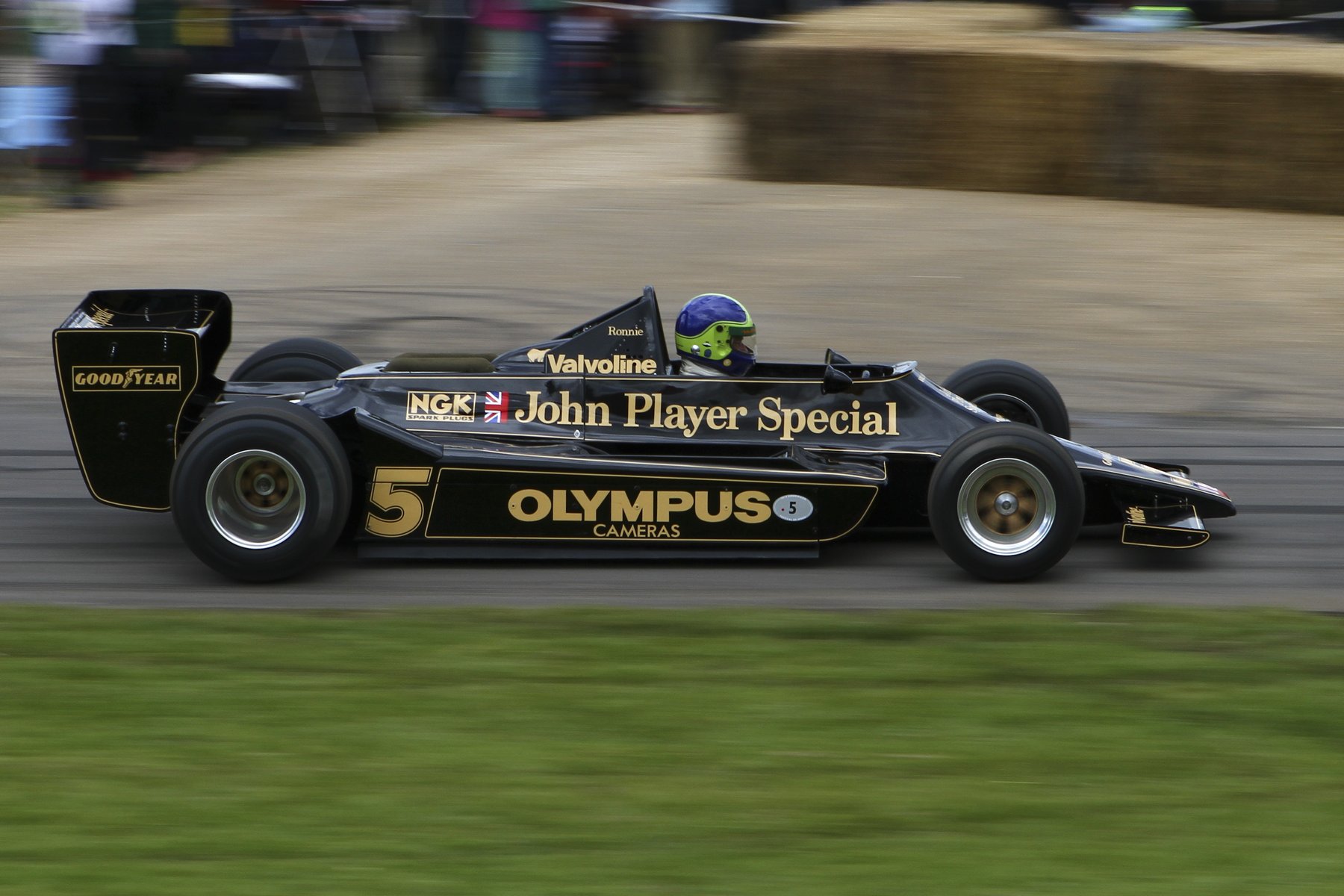
Formula 1 discovered this properly in 1977. The Lotus 78, developed by Peter Wright, Colin Chapman, Tony Rudd, Ralph Bellamy and Martin Ogilvie, debuted at that year's Argentine Grand Prix with inverted-wing profiles built into its sidepods and skirts sealing the gap to the road, and took five wins — four for Mario Andretti, one for Gunnar Nilsson. Its successor, the Lotus 79, fixed the 78's unresolved underbody pressure problems by extending the tunnels further rearward, inside the rear suspension, instead of stopping them abruptly ahead of the rear wheels. It appeared at the 1978 Belgian Grand Prix at Zolder, where Andretti qualified over a second clear and won, and the 79's efficiency was such that it needed less rear wing — ground effect was buying downforce at a lower drag cost than a wing could. Andretti took the 1978 drivers' championship and Lotus the constructors'.
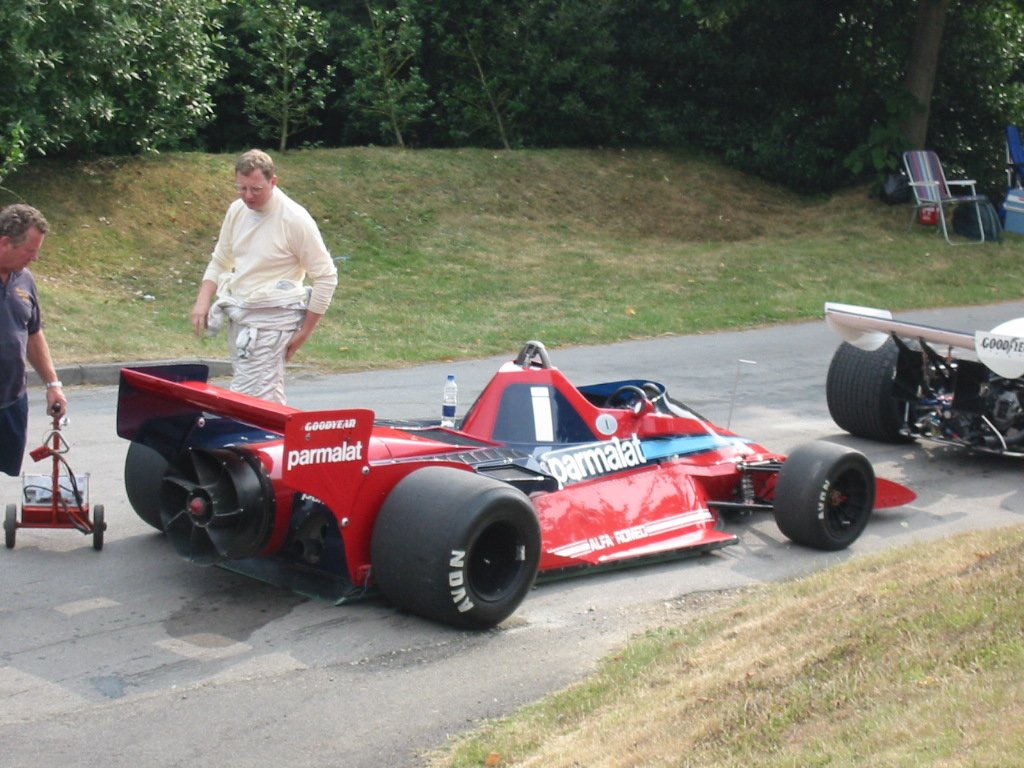
The same season produced the most misreported car in the sport. Gordon Murray's Brabham BT46B used a large engine-driven fan at the rear to extract air from a skirt-sealed volume under the floor — a trick Jim Hall had already run in Can-Am with the Chaparral 2J in 1970, which used two fans driven by an auxiliary two-stroke engine and articulated Lexan skirts, and which the SCCA outlawed after that season. The BT46B raced once, at Anderstorp on 17 June 1978, and Niki Lauda won by over half a minute from Riccardo Patrese. Five teams protested. The regulations banned movable aerodynamic devices, but Brabham's argument was that the fan's primary function was cooling, and the CSI — the sport's technical authority at the time — accepted it. Murray has been emphatic since: "the one thing that's been completely misreported in all the books and magazines is that the car was banned. It was never banned," he told Motor Sport, describing a letter from the CSI confirming it was legal for the rest of the year before the loophole would be closed. What actually happened is that Bernie Ecclestone, who both owned Brabham and ran the constructors' association, was leaned on by rival teams and withdrew the car himself. The result was the same; the mechanism was politics, not a stewards' ruling.
The regulatory thread running through all of this is older than ground effect. After both works Lotus 49Bs crashed at Montjuïc Park in the 1969 Spanish Grand Prix when their tall strut-mounted rear wings collapsed, the CSI met during the Monaco weekend and banned high, suspension-mounted aerofoils outright. The principle — that aerodynamic bodywork must be fixed — has never really gone away. Sliding skirts went next: for 1981, FISA banned them and required a 6 cm ground clearance, which Brabham promptly circumvented with hydropneumatic suspension that sat the car at exactly 6 cm whenever anyone measured it and let it settle onto the road at speed. Flat bottoms were mandated for 1983 after cornering speeds and a brutal 1982 season forced the issue, and shaped underfloors with venturi tunnels only returned to F1 in 2022. Today's FIA technical regulations still require that aerodynamic components and bodywork be rigidly secured and immobile, with the driver-operated DRS flap as the explicit exception. That rule is a direct descendant of 1969.
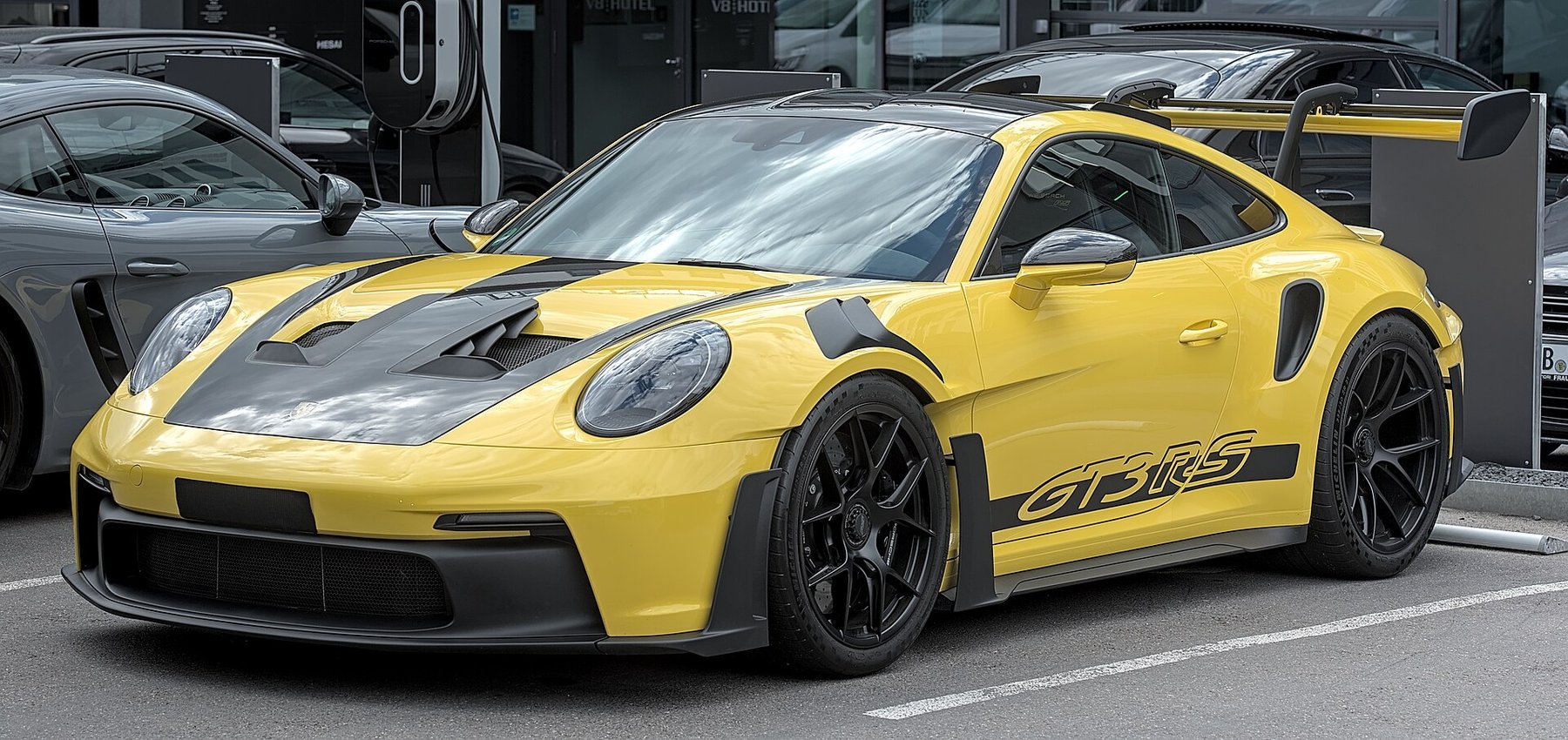
Road cars get a diluted version, for reasons that are mostly about ride height and practicality. A street car has to clear speed bumps, carry luggage, and not sound like a vacuum cleaner, so it can't run the millimetric ground clearance that makes an underfloor work. What it can do is panel the floor flat, add a rear diffuser, and move the wing. Porsche's 992-generation 911 GT3 RS is a usefully documented example because the company published the numbers: 901 lb of total downforce at 124 mph, and 1,896 lb at 177 mph. Note that those two figures are almost exactly the square-law relationship — a 43 percent speed increase roughly doubling the force — with the extra coming from the active wings going steeper. Porsche says that's twice the downforce of the previous 991.2 GT3 RS and three times that of the regular 911 GT3. It gets there by relocating the radiator to a single central unit in the nose, freeing the sidepod space for adjustable front flaps; by hanging a hydraulically adjustable upper element on a swan-neck-supported rear wing that is, Porsche states, the first on a series-production 911 to sit higher than the roofline; by fully panelling and re-finning the underbody; and by a drag reduction system that flattens the wings on straights for a 0.39 drag coefficient and a 184 mph top speed, plus an airbrake mode that slams them to maximum under heavy braking. Even the front wishbones are teardrop-sectioned and worth around 88 lb of front downforce at top speed. Tellingly, the control electronics can also limit downforce so it doesn't exceed the tyres' load rating — proof that the physics works, and that the constraint on a road car is the rest of the car.
Which brings us to the wing bolted to the trunk lid of a hatchback, and why it almost never does anything useful. Two problems, both structural in different senses. The first is where it sits in the air. On a hatchback or a steeply raked saloon, the flow separates near the trailing edge of the roof and the whole rear deck sits inside a turbulent, recirculating wake — CFD work on simplified hatchback bodies shows exactly this separation point. A wing needs clean, attached, fast-moving air to work, because the force it makes is proportional to the dynamic pressure it actually sees. Park an aerofoil in a region where the air is slow, disordered and arriving at the wrong angle, and it produces a fraction of what its area suggests while still collecting drag. That is precisely why serious wings are mounted high, forward of the wake or above it, with swan-neck stanchions that keep the critical low-pressure underside clean. The second problem is the load path. A trunk or hatch lid is a thin, hinged, latched panel designed to keep rain out, not a structural member. Downforce is only worth having if it reaches the tyres through the chassis and suspension; a wing that flexes a sheet-metal lid is converting air pressure into panel deflection, not grip. Wikipedia's own entry on the subject notes that manufacturers sometimes acknowledge outright that their spoilers are fitted for appearance, and that spoilers on upmarket models rarely add aerodynamic benefit. Add the speed problem — at legal road speeds the dynamic pressure is tiny — and a decorative rear wing on a front-drive hatchback is, at best, a styling choice. There's nothing wrong with that. It's just not aerodynamics.
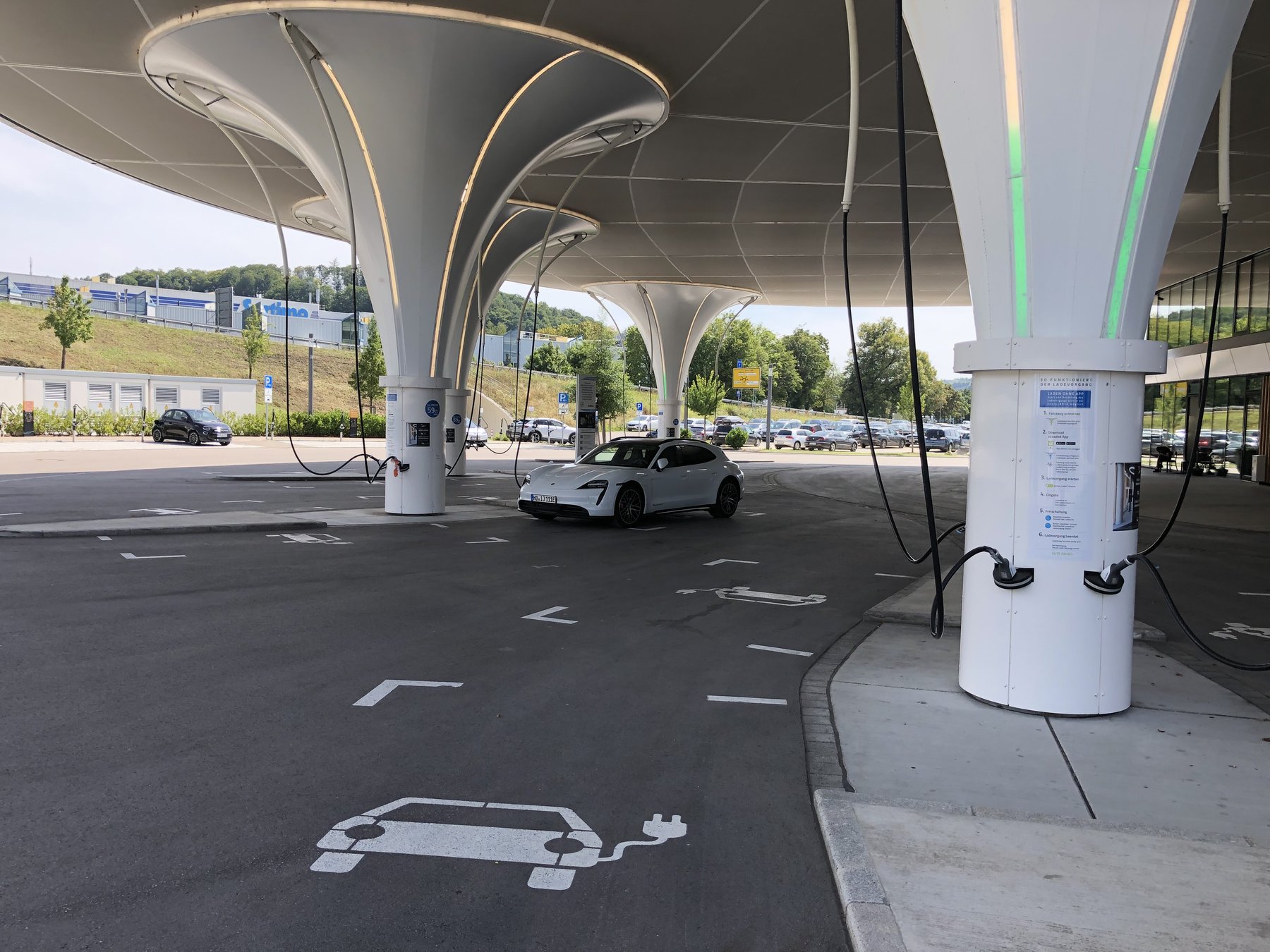
800 Volts Doesn't Make a Car Charge Faster. It Removes the Reason It Couldn't.
Double the pack voltage and you halve the current for the same power — and heat falls with the square of current. That's the entire trick. It still doesn't guarantee you a quick charge, and it quietly creates a compatibility problem nobody advertises.
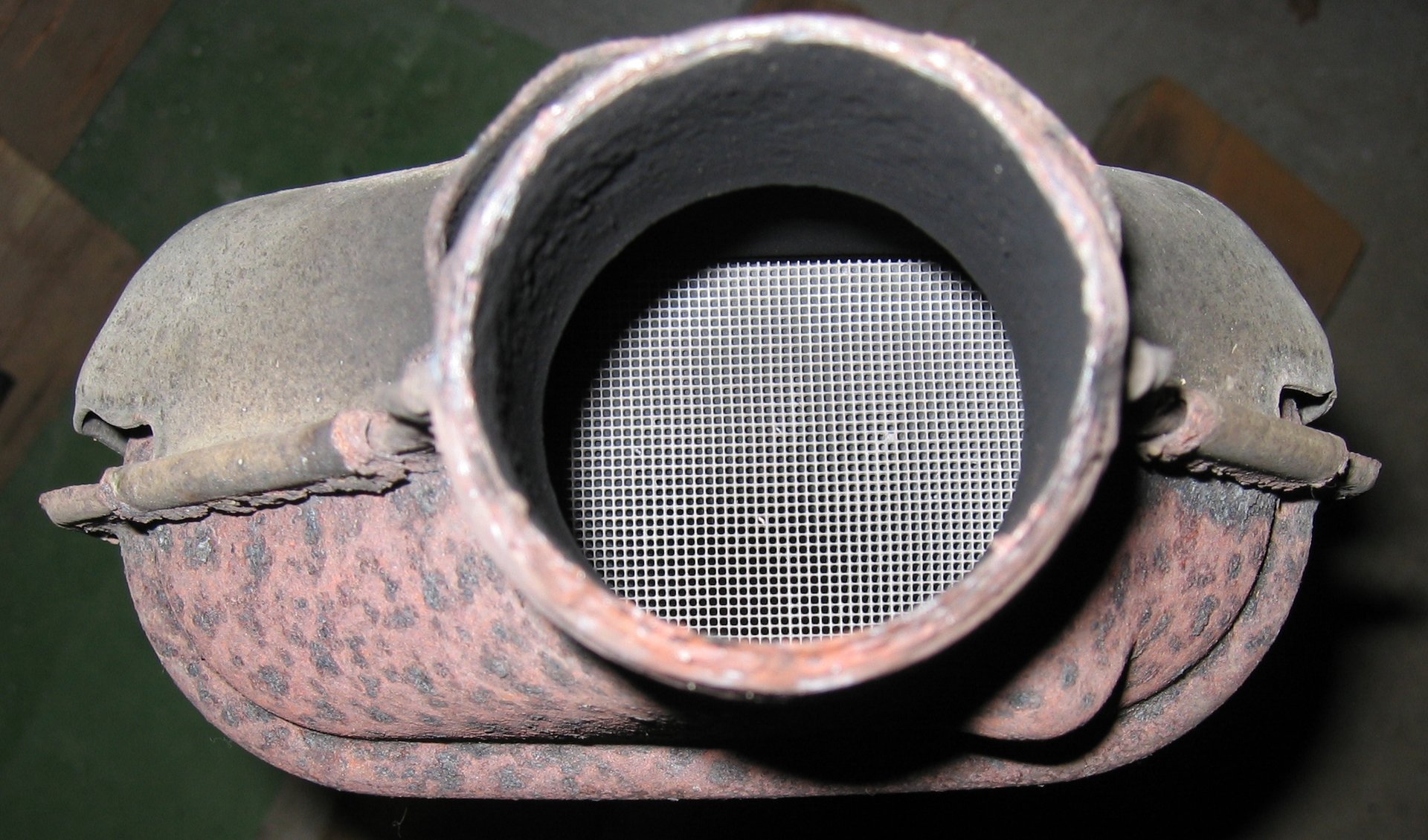
A Catalytic Converter Runs Two Opposite Reactions at Once, and Only Inside a Very Narrow Window
Burning carbon monoxide and unburnt fuel needs oxygen. Stripping nitrogen oxides back to nitrogen needs oxygen taken away. A three-way cat does both in the same brick, which is the whole reason closed-loop fuelling and the oxygen sensor exist.
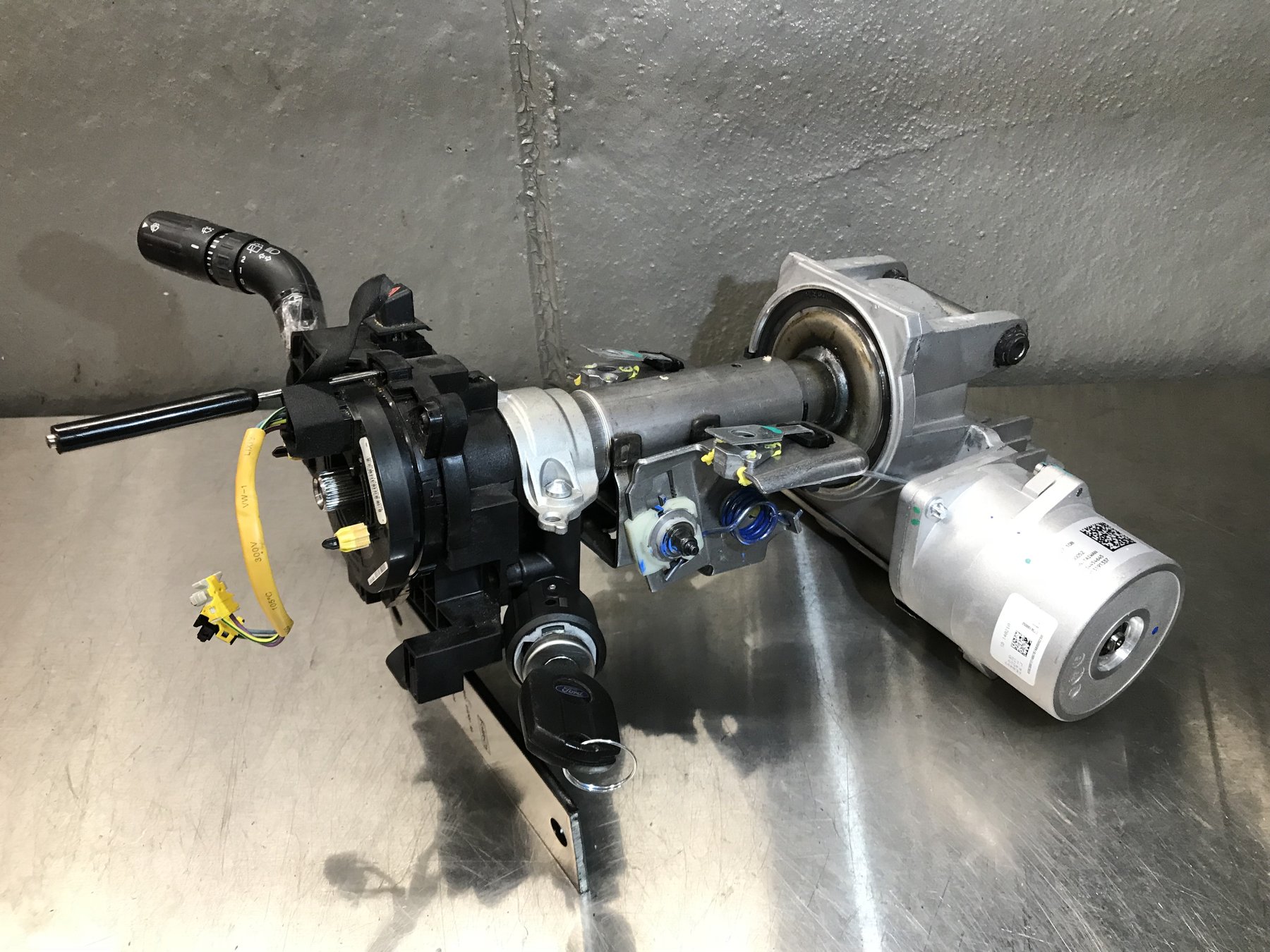
Electric Power Steering Won on Physics. The Missing Feel Was a Tuning Decision.
A hydraulic rack burns engine power whether you are steering or not, and it cannot steer itself — which is why it lost. But "no feel" is not an inevitable consequence of putting a motor in the loop. It is what happens when inertia, friction and software go unaddressed.