
Mazda Says the Next Rotary Will Actually Turn the Wheels — and It Won't Be Bolted to a CVT
Speaking to Car Magazine, a Mazda Motor Europe product planner says the next Wankel won't sit in the nose charging a battery like the MX-30 R-EV's does. No model, no date, no output figure. The thing being promised is a character, not a car.
- Rotary in production today
- 8C, single rotor, 830 cc, Mazda MX-30 R-EV
- Its job
- Range extender — charges the battery, does not drive the wheels
- Stated next step
- Rotary contributes directly to propulsion
- Transmission
- Conventional gearbox; CVT ruled out
- Model
- Not announced
- Timeline
- Not announced
- Output
- Not disclosed
- Nearest concept
- Iconic SP, two-rotor Rotary-EV, Japan Mobility Show, October 2023
- Last rotary production car
- RX-8, ended June 2012
Mazda has spent three years saying the rotary is not dead without ever saying what it is for. That changed slightly this month. Moritz Oswald, who works in product planning at Mazda Motor Europe, told Car Magazine that the company's next rotary application will contribute directly to driving the car — not sit in the nose spinning a generator while electric motors do the work.
"because of the revving, because of the sound, because of the vibration" — Moritz Oswald, Mazda Motor Europe, on why people love the rotary, speaking to Car Magazine
That distinction is the entire story, so it is worth being precise about what Mazda sells today. The MX-30 R-EV uses the 8C: a single-rotor Wankel of 830 cc, rated at around 75 hp, mounted transversely and connected to nothing but a generator. It is a range extender. The wheels are turned by an electric motor, always, and the rotary's only job is to put electricity back into the battery when the battery runs low. You can hear it. You cannot drive it.
The version Oswald described works the other way round: the car pulls away on electric power, and the rotary joins in and takes a share of propulsion when it is needed. That is a parallel hybrid rather than a series one, and it is the difference between an engine you listen to and an engine you use.
Asked why Mazda keeps returning to an engine that is harder to make clean than a piston four, Oswald's answer was about character rather than efficiency. People love the rotary, he said, "because of the revving, because of the sound, because of the vibration." None of those three things survive being wired to a generator at a fixed, efficient rpm.
He also ruled something out, which in this kind of interview is usually more informative than what gets ruled in. There will be no CVT. Oswald's objection was the familiar one — a continuously variable transmission blunts the sense of connection between throttle and drivetrain, and the gear-change event is part of what makes a high-revving engine worth revving. A rotary whose selling point is the climb to its redline, attached to a transmission designed to keep engine speed as constant as possible, would be an odd piece of product planning.
Now the caveats, and there are a lot of them. Mazda has not named a model. It has not given a launch window. It has not published a displacement, a rotor count, a power figure, or a fuel. Oswald would not be drawn on a production date. What exists is a statement about what the engine is supposed to do, from someone whose job is planning products, in an interview — not a press release, not a prototype, not a date.
The hardware hints come from elsewhere. Outlets covering the interview have pointed to a 2023 Mazda patent filing describing a rotary-specific exhaust gas recirculation arrangement for a twin-rotor, turbocharged engine, splitting exhaust between peripheral and side ports so that hot gas goes to the turbo and cooler gas is routed back into the intake. That is a plausible answer to one of the Wankel's oldest problems — the engine's combustion chamber is long, thin and moving, which burns fuel slowly and throws unburnt hydrocarbons out of the exhaust — but a patent is a record of an idea, not a commitment to build it.
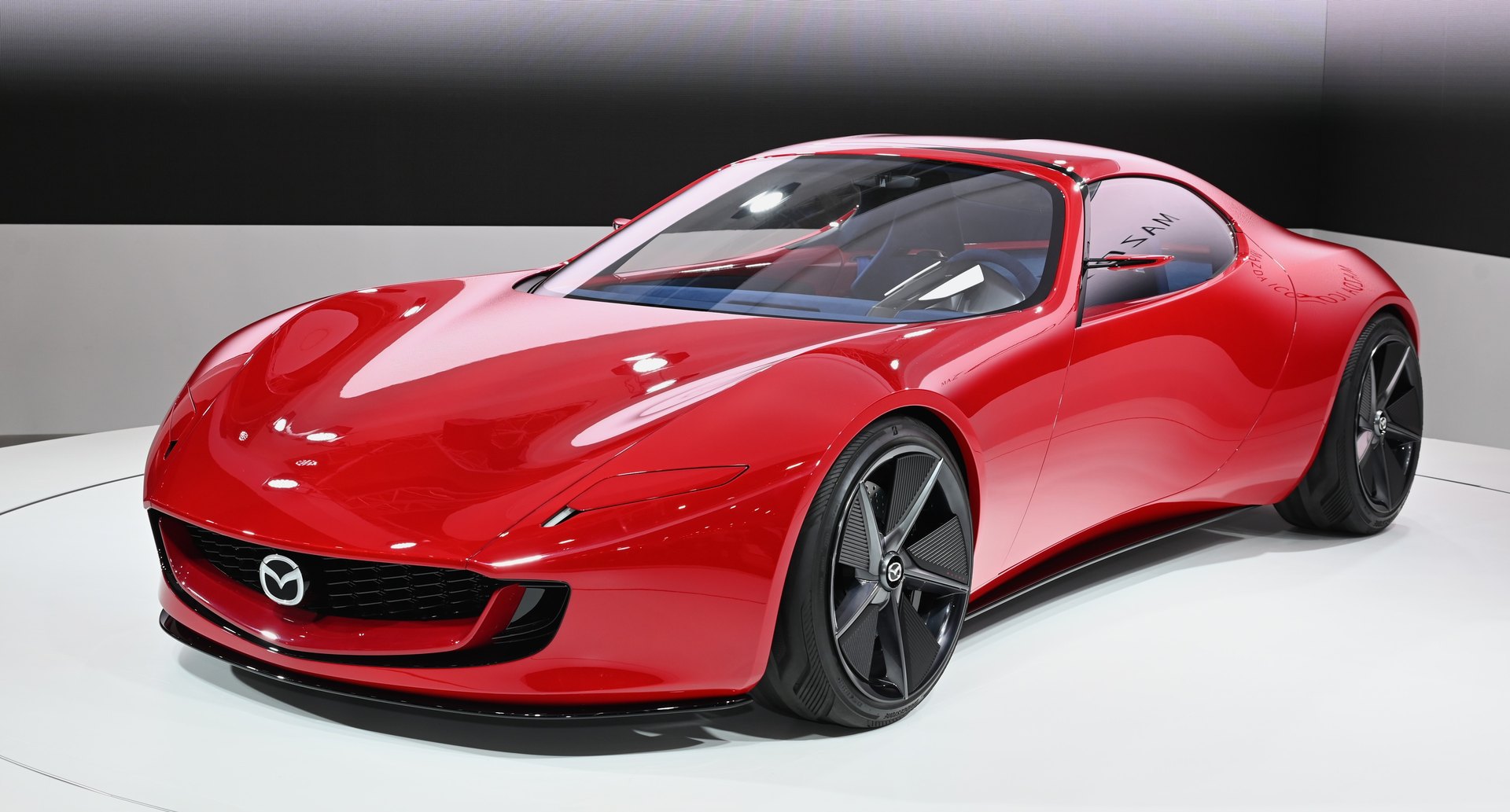
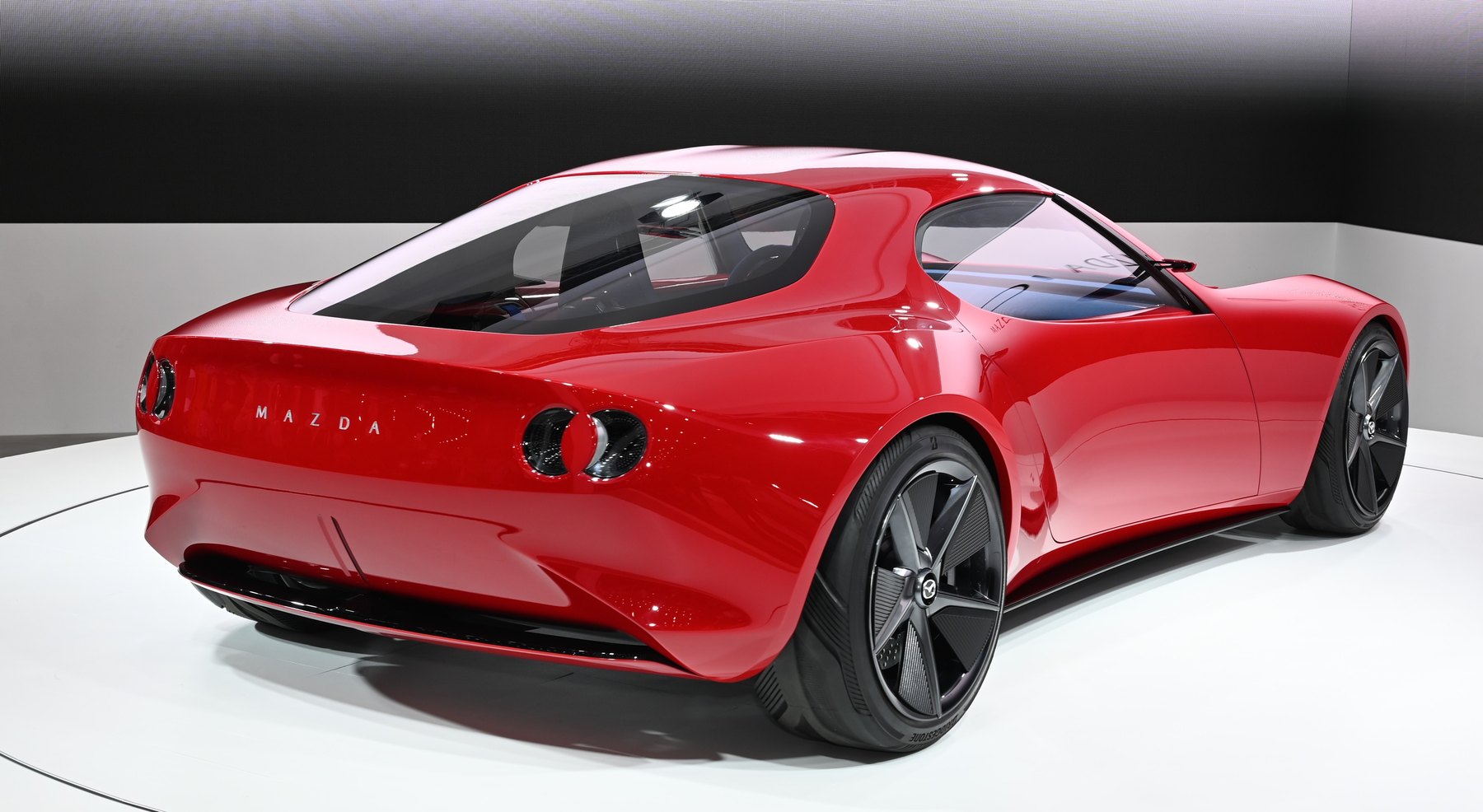
The only shape Mazda has ever put on this idea is the Iconic SP, shown at the Japan Mobility Show in October 2023: a two-rotor Rotary-EV concept, 4,180 mm long and 1,150 mm tall, with a claimed kerb weight of 1,450 kg, pop-up headlights and a roofline that argues openly with the FD RX-7. Mazda said at the time that its rotary could run on hydrogen or petrol and could export power to external devices. It has never said the car is going into production.
What gives any of this weight is the company's history with the engine, which is long enough to have gone through a full cycle of triumph and abandonment. The Cosmo Sport 110S went on sale in Japan on 30 May 1967 as the world's first production twin-rotor car. The 787B won Le Mans outright in 1991 with a four-rotor R26B, and remains the only car to have won that race without a reciprocating engine; rotaries were legislated out of the category immediately afterwards. The RX-8 was the last rotary road car, and it ended production in June 2012.
Eleven years passed between that and the MX-30 R-EV, and the thing that came back was an engine doing a job nobody who cared about rotaries wanted it to do. Oswald's comments are the first time anyone at Mazda has said plainly that the next one will not be that. Whether it arrives attached to a car is still an entirely open question.
Tesla Showed a Roadster That Does Kickflips. The FAA Says It Isn't an Aircraft, and Nobody Will Say What It Is.
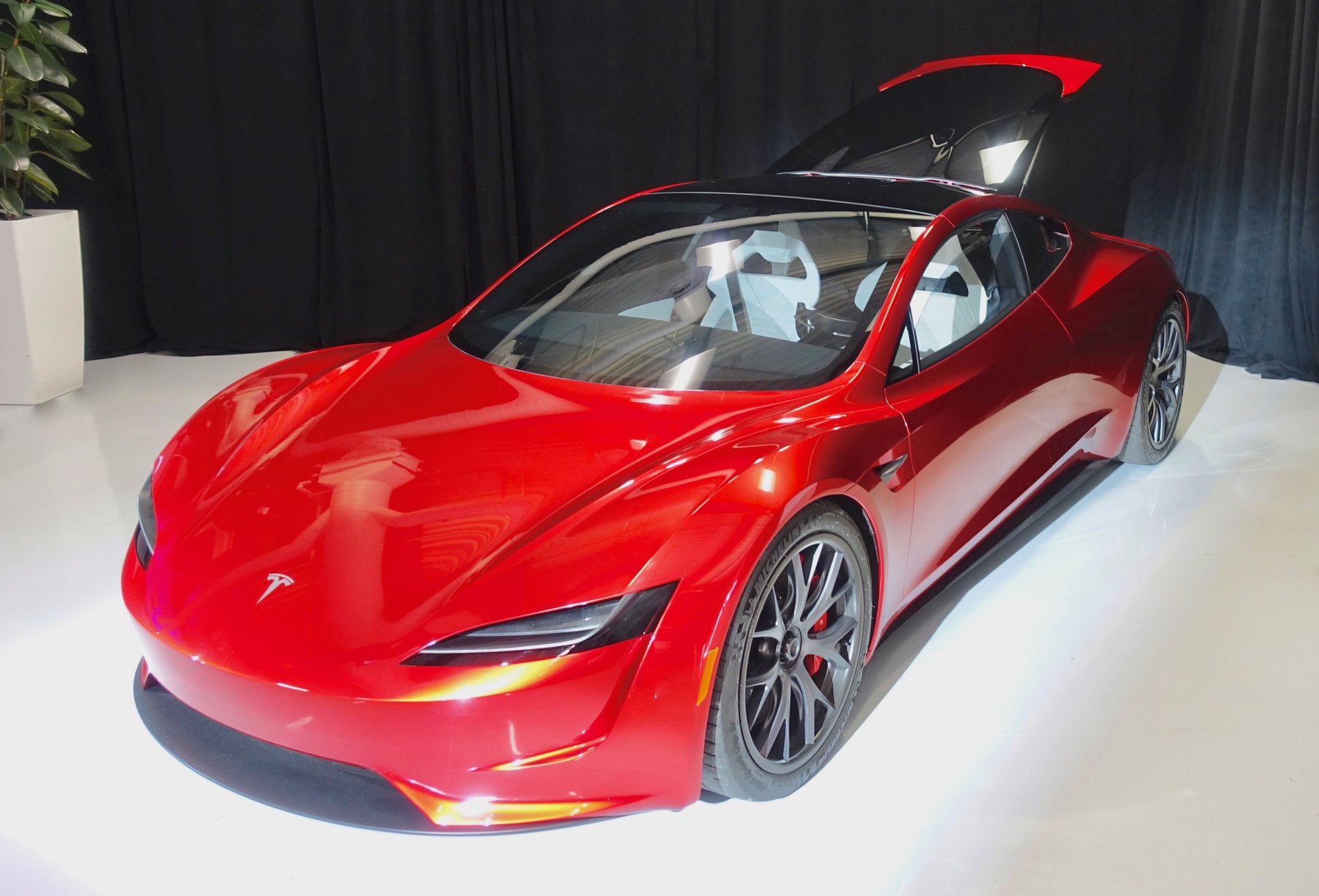
Nine years after taking deposits on a car promised for 2020, Tesla unveiled a four-trim Roadster that drives upside down, flips in mid-air, and carries about five seconds of compressed nitrogen. Production is now 2028. There is still no price.
Nissan Finally Put a Third Pedal in the Z NISMO. Then It Made Sure Almost Nobody Can Buy One.
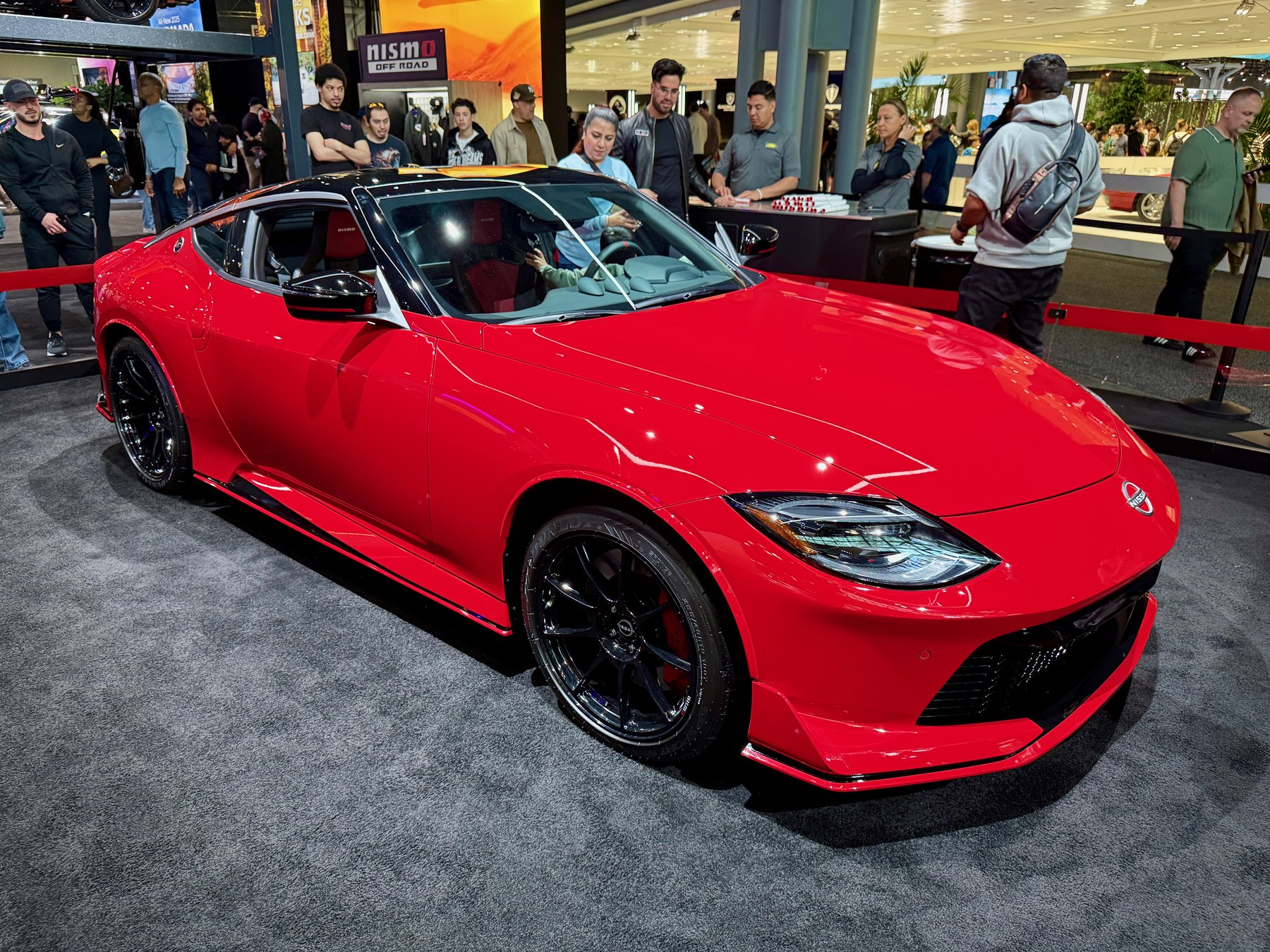
420 horsepower, GT-R brakes, seven percent shorter throws, and no price premium over the automatic. Also: a reported allocation of two or three Zs per dealer for the entire model year, and a manual NISMO build share in the single digits.
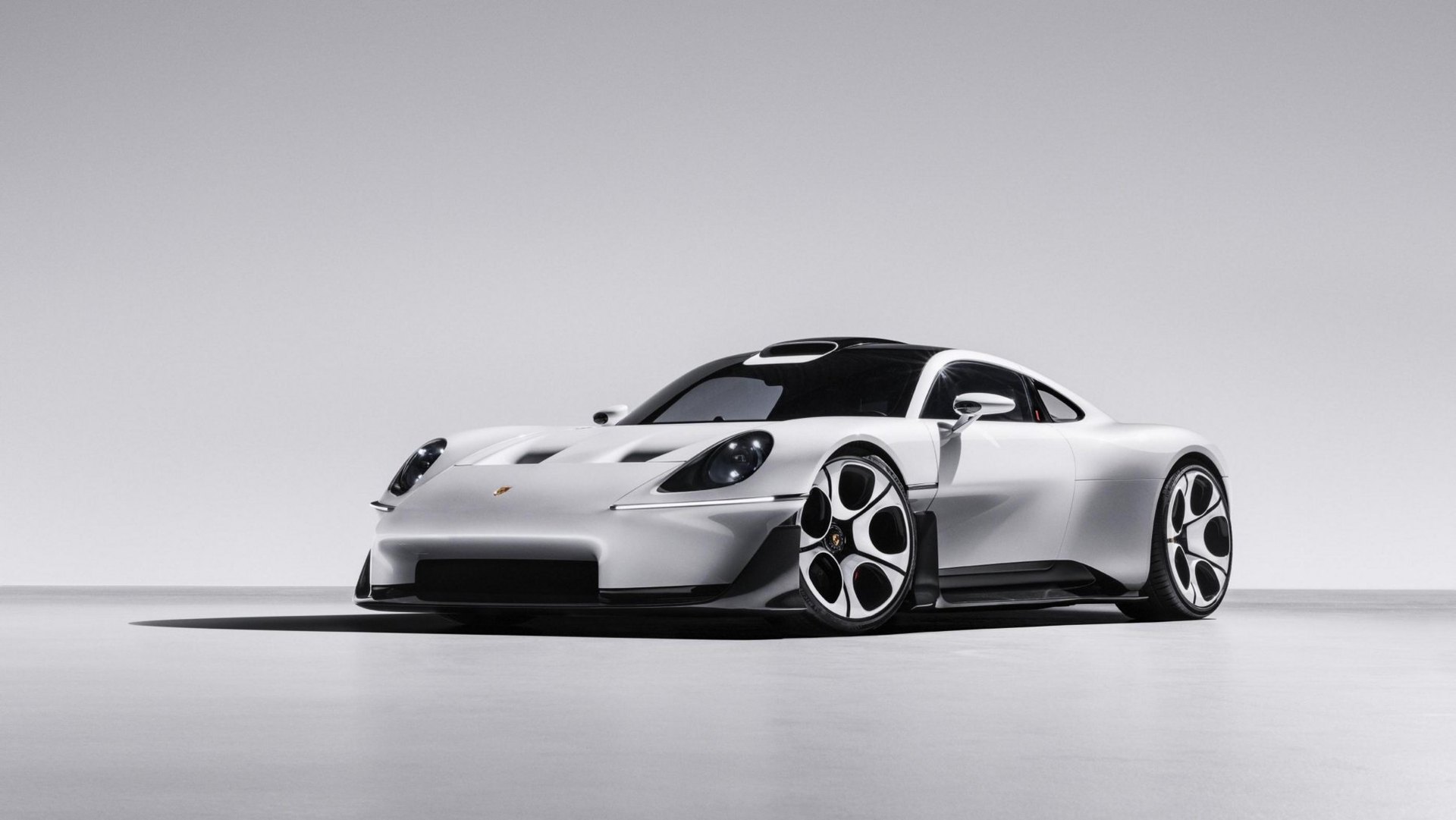
Porsche Puts a Mid-Engined Car Above the 911 — and an Analogue Rev Counter in Front of the Driver
The Mission S vision model landed on a Queens pier on Thursday with five round dials, no fixed centre screen and a confirmed platform above the 911. What Porsche carefully did not say is what sits behind the seats.